
The days of simple business operations are long behind us. Today’s organizations face rapid growth, evolving risks, shifting regulations, globalization, and a flood of technology and data. For a GRC board, keeping strategy, performance, and risk aligned amid all this complexity is no small feat.
The board's role in GRC has never been more critical — helping executives and management teams navigate uncertainty and stay in sync with constant change.
GRC (governance, risk management and compliance) by definition starts with the G for governance. Because of the board's role in corporate governance, one would think that GRC is a board-driven strategy and initiative. However, the opposite is most often the case. It is the R for risk management and C for compliance that drive most GRC initiatives — and fail to engage senior executives and the board who ultimately have fiduciary obligations for all aspects of GRC.
This article explores how boards can lead effective GRC strategies by covering:
The board's role in GRC encompasses setting strategic direction, approving risk appetite, ensuring adequate resources and holding management accountable for GRC performance across the enterprise.
Boards hold ultimate accountability for governance, risk management and compliance — a responsibility that cannot be delegated despite operational execution residing with management.
This accountability has intensified as regulatory scrutiny increases and stakeholders demand greater transparency. According to What Directors Think 2025 research conducted by Corporate Board Member, FTI Consulting and Diligent Institute, strategy has emerged as the most challenging issue for directors to oversee at 42%, surpassing cybersecurity for the first time in years.
Additionally, 24% of directors identify enterprise risk management as a significant oversight challenge, reflecting the complexity boards face in connecting GRC activities to strategic objectives.
The board's role now extends beyond reviewing periodic reports to actively shaping how organizations approach governance, risk and compliance as interconnected disciplines.
Effective boards establish clear expectations for the information they need, create accountability structures that ensure management execution, and continuously evaluate whether GRC investments deliver value in proportion to the resources consumed.
Boards define the governance framework that shapes how organizations make decisions, allocate resources and hold leadership accountable. This includes:
Strategic direction requires boards to understand how GRC activities support business objectives rather than viewing governance, risk and compliance as separate compliance exercises.
GRC, as detailed in the OCEG GRC Capability Model, drives principled performance. It represents an organization's capability to reliably achieve objectives (governance), while addressing uncertainty (risk management) and acting with integrity (compliance). The flow starts with governance, which provides context for risk management and compliance.
This is the governance function of GRC — to set, direct and govern the reliable achievement of objectives. Objectives can be overall entity-level objectives, but also can be divisional, departmental, project, process or even asset-level objectives.
Governance involves directing and steering the organization to reliably achieve objectives.
This is the risk management function of GRC. ISO 31000 defines risk as "the effect of uncertainty on objectives." Good risk management is done in the context of achieving objectives — to optimize risk-taking to ensure that the organization creates value.
This is the compliance function of GRC. It extends beyond regulatory compliance to encompass the organization's adherence and integrity in meeting its commitments and obligations.
These commitments and obligations can stem from regulations, but also can be found in ethical statements, values, codes of conduct, ESG commitments and contracts.
As you can see, GRC by definition and concept flows from governance into risk management and compliance. However, most organizations implement GRC strategies that start with risk and compliance and fail to connect or even consider governance. Boards have both the responsibility and authority to correct this fundamental misalignment.
"There needs to be collaboration between risk and the business, vertically up and down, but then also horizontally across the organization. It is absolutely essential — collaboration across risk departments. The problem is that there are silos. Risk and audit are interconnected and interdependent. Collaboration helps provide audit's perspective, their insight across company policies and procedures that help improve risk's function," says Michael Rasmussen, CEO of GRC Report.
Rasmussen identifies the fundamental challenge facing most organizations: GRC functions operate in isolation when they should work as an integrated system. When risk management, audit and compliance teams maintain separate processes and reporting structures, organizations lose the critical connections between these disciplines.
A compliance issue may signal broader risk exposures, while an audit finding may reveal governance gaps that affect strategic decision-making. These relationships remain invisible when teams work in departmental silos.
This interconnectedness and demand for contextual awareness apply to the world of business. Organizations need contextual awareness of GRC to understand the intricate relationships among objectives, risks and integrity across the enterprise.
Without this integrated view, boards cannot effectively oversee how governance decisions impact risk exposure, how compliance obligations constrain strategic options or how risk-taking aligns with approved objectives.
The core issue is that in GRC, the ‘G’ often goes silent. Too frequently, organizations approach GRC from a compliance, audit or risk perspective, leaving governance buried deep within departments instead of driving a top-down, board-led strategy.
True GRC should be an integrated discipline that connects governance with performance and decision-making at the highest level.
Organizations need to understand how to monitor risk-taking in the context of governance and objectives, measure whether associated risks taken are the right risks to achieve objectives, and review whether risks are effectively managed.
Organizations that take a board-driven approach to GRC led from the top realize significant advantages in organizational performance, risk management effectiveness and compliance maturity.
These benefits extend beyond avoiding regulatory penalties to creating competitive advantages through superior governance infrastructure.
When boards actively lead GRC strategies, organizations become:
Boards need synthesized intelligence that highlights significant exposures, emerging threats and risk appetite alignment — not raw data dumps from operational departments.
The What Directors Think 2025 report reveals that only 30% of directors rate their board's ability to understand the company's long-term strategy as "excellent," evidencing the challenge with maintaining this alignment.
Agility allows an entity to use GRC to its advantage, grasp strategic opportunities and be confident in its ability to stay on course.
"Resilience is key," says Lisa Bougie, speaker at Diligent Institute's Elevate Leadership Summit. "To build resilience, an organization needs to both acknowledge known risks and appreciate the reality of uncertainty. Scenario planning can help to ensure an organization is as prepared as possible when the unexpected hits."
Discover how modern platforms unify governance, risk and compliance oversight for board-level decision making.

Beyond setting strategic direction, boards must create organizational conditions that enable effective GRC execution.
This requires establishing governance structures, allocating resources appropriately, ensuring management accountability and continuously evaluating program effectiveness.
Boards should define explicit accountability for governance, risk management and compliance activities across the organization. This includes clarifying:
Effective governance structures also address committee responsibilities. Many boards are reevaluating committee structures to ensure they don't overburden audit committees with expanding GRC responsibilities.
Diligent’s 2025 Risk and Opportunity Outlook report emphasizes that "the winners will be the companies that recognize that risk and opportunities need to be standing discussion topics on the board agenda. Think about changing your committee structure to reflect this — and make sure that you aren't throwing everything under the Audit Committee's purview."
Organizations need appropriate GRC technology platforms that provide boards with real-time visibility into risk exposure and compliance status.
The What Directors Think 2025 survey reveals that 37% of directors believe implementing new tools and technology at the board level would help modern boards function better, ranking third among all potential improvements.
"Tell the board what they need to know, not what you know," says David Platt, Chief Strategic Development Officer at Moody's.
This principle recognizes that boards need synthesized intelligence delivered through technology platforms that aggregate data from across the enterprise and present actionable insights rather than overwhelming detail about departmental activities.
Board-driven GRC requires mechanisms for learning from incidents, near-misses and changing conditions.
Organizations should establish processes for capturing lessons learned, updating risk assessments based on new information, and adjusting governance structures as business strategy evolves.
"2025 is the year we put the 'G' back in ESG," notes Pav Gill, CEO of Confide. "The strongest defense against emerging risks lies in sound, well-structured governance systems."
The takeaway? Governance infrastructure creates the foundation for effective risk management and compliance — not the reverse.
Effective GRC requires partnership between boards and management rather than adversarial oversight relationships. Boards should create environments where management feels comfortable escalating emerging risks, admitting uncertainties and requesting resources for capability development.
The What Directors Think survey reveals shifting board information needs. Beyond the CEO and CFO, 35% of directors want to hear more from the Chief Human Resources Officer, 31% from the Chief Marketing Officer, and 24% from the Chief Technology Officer.
This diversification of board-management dialogue reflects the expanding scope of GRC oversight beyond traditional financial and legal domains.
For boards navigating today's complex GRC landscape, AI-powered governance platforms provide the integrated visibility and intelligence needed to fulfill oversight responsibilities effectively.
These solutions address the fundamental challenge where most organizations maintain siloed GRC and finance systems, preventing comprehensive risk visibility.
The Diligent One Platform delivers comprehensive GRC capabilities that integrate board management, enterprise risk management, compliance tracking and audit activities in a single unified interface.
This consolidation enables boards to see how governance decisions impact risk exposure, how compliance obligations constrain strategic options and how risk-taking aligns with approved objectives.
The platform's board-ready reporting templates synthesize data from across the enterprise into actionable intelligence.
AI-powered analytics identify significant patterns, emerging threats and risk appetite deviations that require board attention, rather than overwhelming directors with operational detail.
Diligent Boards transforms board engagement with GRC oversight through AI-powered preparation capabilities. Smart Risk Scanner automatically identifies risky language and legal red flags in board materials before meetings, while Smart Prep Insights generates pointed questions by topic with supporting citations.
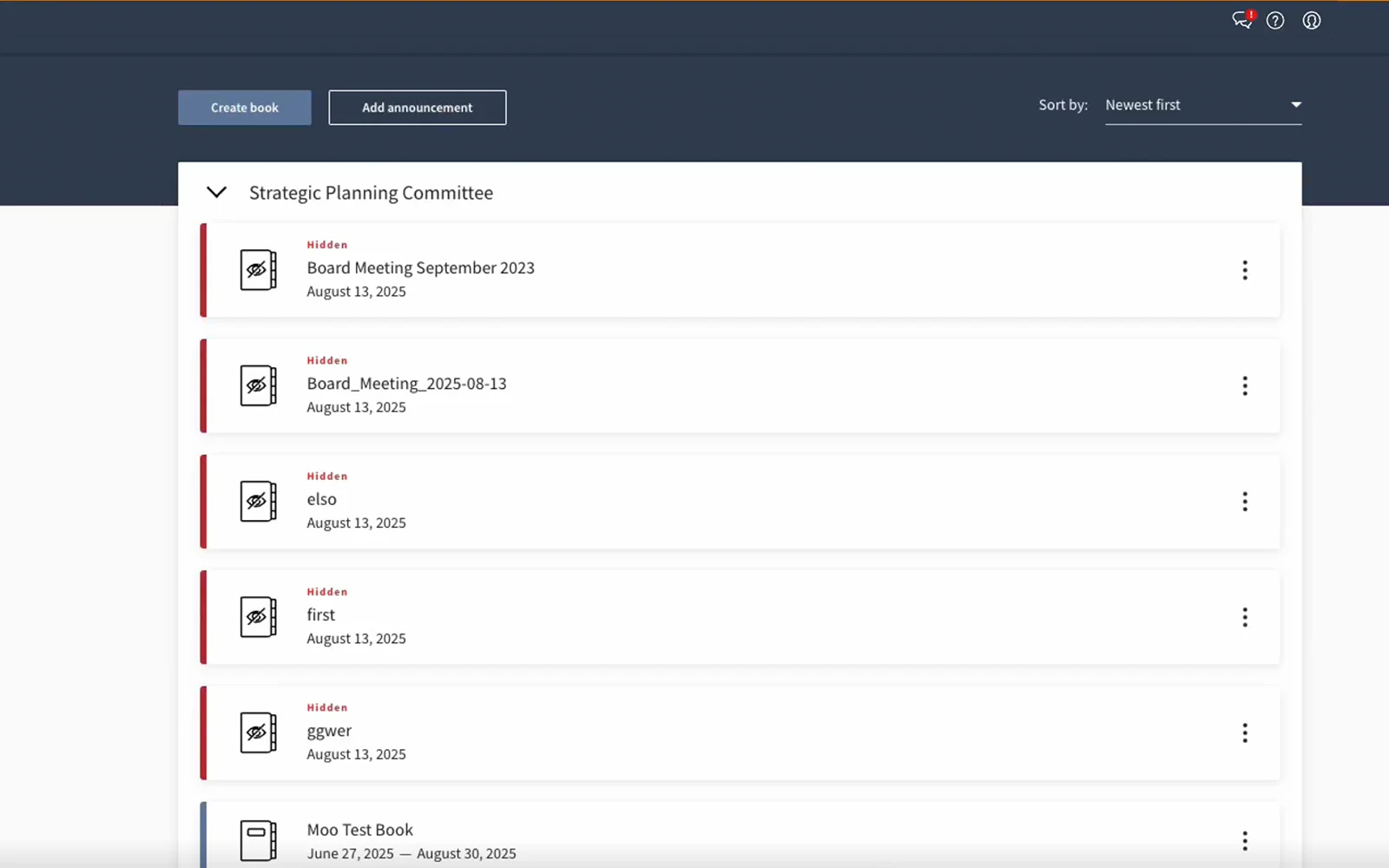
Additionally, Smart Builder reduces board preparation time, eliminating manual compilation burden and enabling boards to focus meeting time on substantive GRC discussions.
For organizations requiring sophisticated risk management, Diligent ERM provides comprehensive risk orchestration across business units and geographies.
The platform's AI-powered risk identification benchmarks organizational risks against 180,000+ real-world risks from SEC 10-K reports, while integration with Moody's Risk Benchmarking Data delivers external risk intelligence and credit sentiment scores.
This combination enables board-level discussions grounded in both organizational context and industry standards.
Together, these solutions provide the integrated platform capabilities that enterprise organizations need to mature from reactive, department-led GRC to proactive, board-driven governance.
Ready to strengthen your board-level GRC oversight with AI-powered intelligence? Schedule a demo to see how Diligent transforms governance, risk and compliance oversight.
GRC stands for governance, risk and compliance — an integrated approach to organizational oversight that connects how companies achieve objectives (governance), address uncertainty (risk management) and act with integrity (compliance).
It matters to boards because they hold ultimate accountability for all three elements and cannot effectively oversee them in isolation.
Boards should evaluate whether their current committee structure appropriately distributes GRC responsibilities or overburdens specific committees — particularly audit committees — with expanding oversight obligations.
Consider creating risk committees for organizations with significant risk exposures and establishing protocols for cross-committee coordination on issues spanning multiple domains.
Boards need synthesized intelligence rather than operational data dumps.
Essential information includes:
Boards must establish AI governance frameworks defining acceptable use cases, risk tolerances for AI deployment and mechanisms for monitoring AI system performance.
This requires board-level understanding of AI capabilities and limitations rather than complete delegation to technology departments.
Schedule a demo to see how integrated platforms enable the board-led oversight approach that delivers superior results.