
In this article

AI governance is emerging as one of the most pressing strategic challenges facing boards and governance leaders today. According to the Q4 2025 Business Risk Index conducted by Diligent Institute and Corporate Board Member, 60% of legal, compliance and audit leaders now cite technology as their top risk concern — well ahead of economic factors (33%) and tariffs (23%). Yet despite this urgency, only 29% of organizations have comprehensive AI governance plans in place.
"Boards are racing to harness AI's potential, but they must also uphold company values and safeguard the hard-earned trust of their customers, partners and employees," says Dale Waterman, Principal Solution Designer at Diligent.
The challenge is clear: How do organizations accelerate AI adoption to support transformational objectives while managing the risks and opportunities it creates? The answer lies in effective AI governance.
AI governance is the set of frameworks, policies, controls and accountability structures that determine how an organization develops, acquires, deploys and oversees artificial intelligence systems. It establishes the guardrails that let organizations innovate while protecting stakeholders from harm, and it makes clear who is responsible when something goes wrong.
It sits at the intersection of four pressures: regulation (the EU AI Act, NIST AI Risk Management Framework and ISO/IEC 42001), board fiduciary duty, enterprise risk exposure and stakeholder trust. Every organization deploying AI needs governance, but the responsibility cuts across boards, risk, compliance, audit, legal and the business units actually using the technology.
In practice, responsible AI governance has to account for:
Corporate governance arose to balance the interests of all stakeholders — leadership, employees, customers, investors and more — fairly and transparently. AI governance matters for the same reason: it puts ethics, accountability and safety at the center of how AI is built and used. Without good governance, AI can produce unintended consequences, from discrimination and misinformation to security and compliance failures.
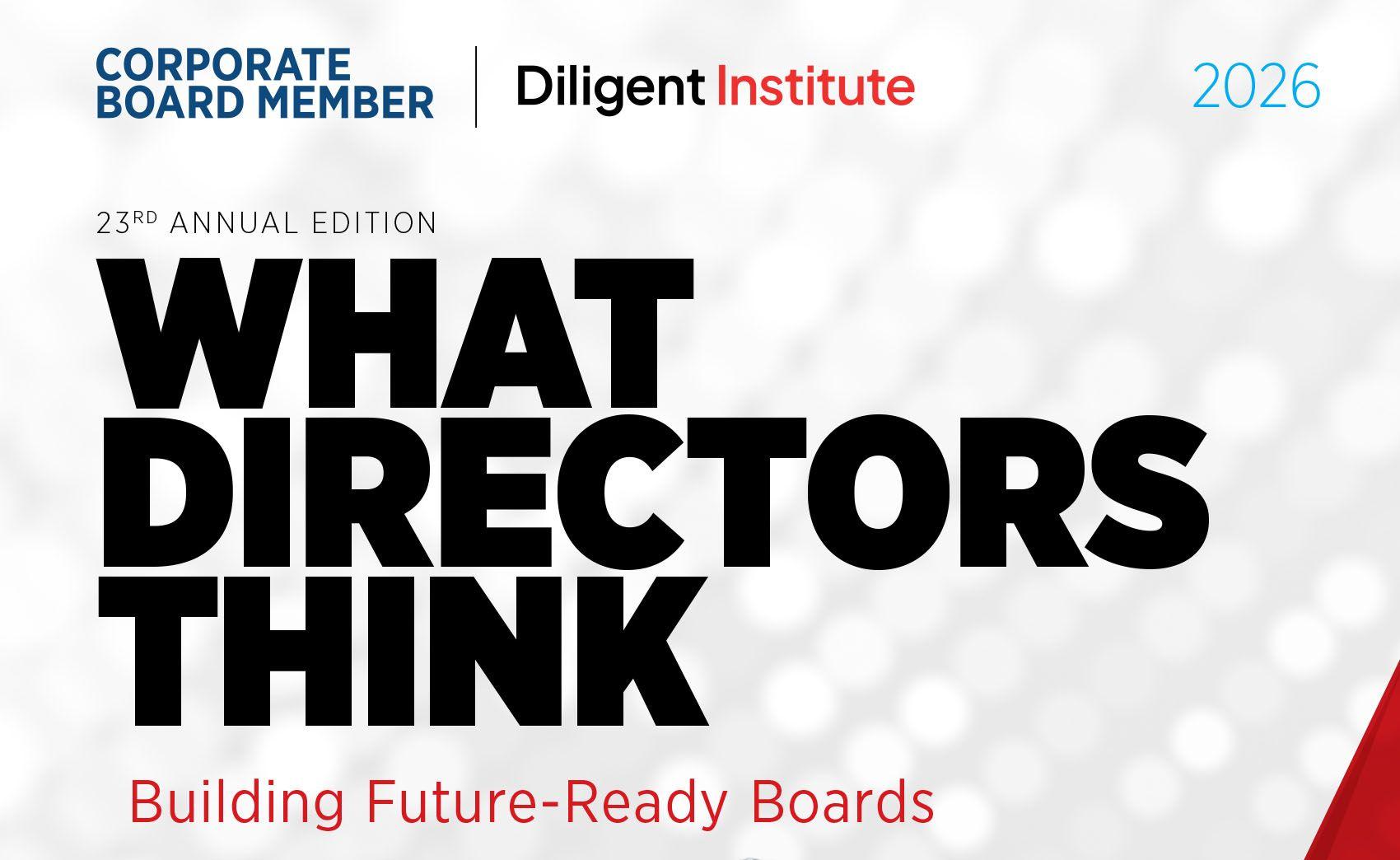
The urgency is visible in the data. In the 2026 What Directors Think report from Diligent Institute and Corporate Board Member, 40% of directors named technological developments, including AI, as the single most challenging issue to oversee. Only 8% rate their board as having strong AI expertise — the lowest score across every area surveyed — and 50% point to AI and technology regulation as the top compliance area to watch, even as 41% call it the most underestimated.
The same gap shows up globally. In the 2026 APAC Governance Outlook report, the Diligent Institute, with the Governance Institute of Australia and Singapore Institute of Directors, found that 65% of senior governance leaders cited a lack of governance processes to guide agentic AI decision-making as a top concern. The tools are arriving faster than the oversight around them.
"These days, the vast majority of management and board meetings at least bring up AI. Simultaneously, it holds tremendous opportunity and risk because of how disruptive the technology is," says Dottie Schindlinger, Executive Director of Diligent Institute.
A strong AI governance approach pays off because it:
Boards must balance competing priorities when overseeing AI: enabling innovation that drives competitive advantage while managing risks to data privacy, security and stakeholder trust.
"Have a candid assessment of what your board's capabilities are, what your C-suite's capabilities are. The board needs to apply an appropriate level of governance pressure to someone who's going to oversee the AI landscape, the risk exposure, the disruption and the opportunity," says Keith Enright, VP and Chief Privacy Officer at Google and Board Director at ZoomInfo.
Responsible AI governance requires boards to address five key areas:
Boards are not expected to build AI systems. They are expected to make sure management has built the right ones, then exercise informed oversight. In practice that includes approving the AI policy and risk appetite, confirming which committee owns AI (audit, risk, technology or a dedicated AI committee), reviewing the AI inventory and material AI risks at least annually, reviewing incidents and management's response and ensuring the board can access enough AI expertise to challenge management credibly.
The expertise gap is real. What Directors Think 2026 found that 66% of directors already use AI for board work, but only 22% have governance processes in place for the board's own AI usage — and 28% now name AI expertise as a top recruitment priority. AI is moving faster than the oversight model around it.
"Have a candid assessment of what your board's capabilities are, what your C-suite's capabilities are. The board needs to apply an appropriate level of governance pressure to someone who's going to oversee the AI landscape, the risk exposure, the disruption and the opportunity," says Keith Enright, VP and Chief Privacy Officer at Google and Board Director at ZoomInfo.
As Richard Barber, CEO of MindTech Group, puts it: "Put AI in your risk register. No one's going to argue with that. Get an AI policy. The board should be asking management for a policy."
In practice: Mining group Assore Holdings used Diligent's AI-powered board tools to cut board-meeting preparation time by up to 60%, freeing directors to spend oversight time on judgment rather than document wrangling.
Master the five factors influencing AI governance today to help your board navigate the complex interplay between innovation and risk.

AI governance is often described as a technical or regulatory discipline. That understates what is happening. AI governance is a corporate governance discipline, and it is the board, audit committee and risk committee that decide whether an organization governs AI well.
Treating it as a corporate governance question matters for three reasons:
The practical task for corporate secretaries, general counsel and governance committees is translation: turning abstract "AI governance" language into specific charter updates, board-level KPIs, executive accountability and disclosure language. For more on that angle, see Diligent's guidance on boards governing AI.
Once an organization commits to AI governance, the next question is usually: Which framework do we use? For most enterprises the answer is some combination of three, mapped together so they don't run on parallel tracks.
An AI governance framework is a structured set of principles, processes and controls for managing the development and use of AI. It typically covers risk identification, accountability, transparency, technical robustness, human oversight, monitoring and continuous improvement. Frameworks are either voluntary standards (NIST, ISO, OECD) or binding law (the EU AI Act, sectoral US rules), and most mature programs use a voluntary standard to operationalize compliance with binding law.
The NIST AI Risk Management Framework organizes AI risk into four functions: GOVERN, MAP, MEASURE and MANAGE. For boards and risk committees, GOVERN is the most relevant. It addresses the policies, roles, accountabilities and risk tolerances that have to exist before any technical control matters — setting tone at the top, defining accountability, ensuring resources and confirming that AI risks are integrated into enterprise risk management. For organizations already operating under the NIST Cybersecurity Framework, the AI RMF should feel familiar in structure.
ISO/IEC 42001, published in late 2023, is the first international management system standard for AI. It is built like ISO 27001, with which it integrates cleanly: leadership, policies, risk assessment, controls, internal audit, management review and continuous improvement. Certification is possible and is starting to appear in RFPs and customer security questionnaires, and the standard is technology-agnostic, so it covers both the AI you build and the AI you buy.
The EU AI Act classifies AI systems into four risk tiers (unacceptable, high, limited, minimal) and imposes obligations on both providers and deployers. It has extraterritorial reach, so non-EU organizations are in scope if their AI affects people in the EU. Key obligations include maintaining inventories of AI systems and their risk classifications, implementing risk management, data governance and human oversight for high-risk AI, conducting conformity assessments before placing high-risk systems on the market and preserving technical documentation and post-market monitoring evidence.
In practice: Engineering consultancy CBCL Limited used AI Risk Essentials to map and benchmark its AI and enterprise risk against peers, drawing on a library of 185,000+ real-world risk scenarios to turn framework requirements into a working, prioritized risk picture rather than a static checklist.
See how the regulatory and governance response to AI’s opportunities and concerns has varied globally.

Beyond regulation, industry bodies and standards organizations publish technical AI governance standards. They are voluntary, but adopting the relevant ones helps you build quality, safe and efficient AI — and demonstrate maturity to regulators, customers and insurers. NIST AI RMF and ISO/IEC 42001 (covered above) are the most widely adopted; alongside them sit:
Frameworks and standards describe what good looks like. They don't tell you who does what. That is where the three lines of defense model (3LOD) comes in. AI governance succeeds or fails on how the operational, risk and audit functions coordinate, not just on the quality of the policy.
"Technology risk is now the connective tissue across the entire risk register," says Kira Ciccarelli, Senior Manager of Research at Diligent Institute. AI risk is rarely standalone; it shows up bundled with cyber, third-party, operational and reputational risk. The failure mode 3LOD prevents is the common one: AI risk discussed in three tools, by three teams, in three formats. The fix is to coordinate the three lines on one platform so a risk surfaced by the first line flows into the second line's register and the third line's audit plan automatically. For the wider picture, see Diligent's view on balancing AI innovation, risk and compliance.
For multinationals, AI governance is not one program but many. Different legal entities sit under different regulators, and an AI tool that is permissible in one jurisdiction may be high-risk under the EU AI Act and prohibited in another.
For the company secretary, general counsel and entity management team, that creates four practical questions: which AI systems are deployed by which subsidiary, in which jurisdiction; which regulations apply to each system; what documentation each regulator expects and where it is stored; and how board-level oversight is applied consistently across subsidiary boards. In practice this is an entity-level inventory problem first and a regulation problem second. Without a clean source of truth on entity structure and where AI is used inside it, no compliance team can credibly demonstrate "best effort" to a regulator.
AI governance is valuable, but it is genuinely hard to get right — and field feedback from risk, compliance and audit leaders points to a consistent theme: the hard part is rarely writing the policy. It is operationalizing it. The most common AI governance problems fall into two groups.
Structural and regulatory challenges:
Operational pain points (where programs actually stall):
Responsible AI governance rests on a small set of ethical principles that should translate into concrete controls, not aspirations. Five recur across the major frameworks:
The practical test of responsible AI governance is whether each principle maps to a control — bias testing, documented model cards, human-in-the-loop checkpoints — rather than living only in a values statement.
An AI governance policy sets out what an organization considers acceptable development and use of AI. Good policies are clear, easy for employees to follow and aligned with compliance and risk management. What they mandate varies — some prohibit entering proprietary data into public AI tools, others specify which tasks AI may and may not support — but they consistently help organizations prove compliance with regulations and standards, support ethical development, build public trust in responsible use and keep innovation aligned with business goals.
A workable AI governance policy template covers ten core sections. Use this as a starting structure and adapt it to your organization:

Most organizations don't need a perfect program. They need a defensible one they can stand up quickly and improve over time — and, as the field feedback above makes clear, this is where leaders say the real difficulty lies. The eight steps below are what mature programs tend to follow, with the pitfalls that most often derail each one.
Each step has cross-functional dependencies — step 2 needs IT, step 4 needs legal, step 7 needs the board — which is why the platform decision in step 6 carries so much weight.
In practice: The City of Lethbridge moved off manual spreadsheets onto Diligent ERM and compressed a four-year risk-maturity plan into under 12 months, using interactive heat maps and dashboards to give leaders real-time visibility. "Diligent's Risk Manager tool helped move our ERM maturity level quickly," says Bronwyn Jesse, Risk and Controls Manager. The same operational discipline — inventory, scoring, visualization, board-ready reporting — is what turns an AI governance policy into a working program.
AI governance is not a one-time project. It requires continuous improvement as models change, regulation evolves and use cases multiply.
Mature programs continuously monitor performance, drift, bias and incidents. They also build feedback loops so first-line incidents strengthen second-line controls, second-line findings shape third-line audit plans and audit findings inform board-level policy.
They review governance on a clear cadence, with annual policy reviews, semi-annual risk-appetite reviews and at least quarterly refreshes of the AI inventory for high-risk systems. If your program looks the same in 12 months, it is already out of date.
Across the organizations Diligent works with, the same practices show up in the programs that actually work:
Govern AI ethics with confidence Diligent Institute's AI Ethics & Board Oversight Certification helps boards and leaders navigate AI ethics and compliance. Explore the certification
The hardest question after "do we have AI governance?" is "is it any good?" A mature program can answer:
Continuous monitoring of these AI governance metrics is impractical by hand. With the right tooling, board reporting moves from a quarterly slide to an always-current dashboard.
Manual processes struggle to keep pace with AI adoption. Spreadsheet-based policy tracking, email-driven risk assessments and document-based compliance reporting leave gaps that often surface only during audits or regulatory exams.
"Technology risk is now the connective tissue across the entire risk register. We know that boards too are experimenting with new tech like AI tools to enhance oversight, yet relatively few organizations are leveraging AI-powered dashboards for risk monitoring. Closing that execution gap will separate leaders from laggards," says Kira Ciccarelli, Senior Manager of Research at the Diligent Institute.
The Diligent One Platform unifies governance, risk and compliance into one connected infrastructure, reducing the silos that let AI governance gaps go undetected. Within it, several solutions address the challenges documented above.
Diligent Boards gives directors and corporate secretaries an AI-aware board environment. Smart Builder synthesizes source materials into professional board books in a fraction of the manual time, Smart Risk Scanner flags risky language and legal red flags before materials reach the board and SmartPrep generates pointed, cited discussion questions so directors arrive ready to challenge management on AI strategy. It all runs inside a closed-loop AI environment with the same hosting, permissions and audit trails as the rest of the board's materials.
For boards and governance teams, that matters. The AI operates inside a secure, permissioned environment, so customer content is not used to train public foundation models. Sensitive board materials also do not need to be pushed into unmanaged, consumer-grade tools. That means directors can get the efficiency benefits of AI while maintaining confidentiality, auditability, and control.
In practice: "The AI enhancements will take that further. It's more automation and more insights — what can be drawn out of the information instead of just managing it," notes a customer in Diligent's Sagic case study.
Diligent ERM tracks AI systems alongside other enterprise risks, supporting classification by risk level and jurisdiction in line with the EU AI Act and NIST AI RMF. Risk heatmaps and dashboards surface AI risk next to operational, financial and compliance risk, Moody's benchmarking compares posture against peers and board-ready reporting connects AI governance to board KPIs.
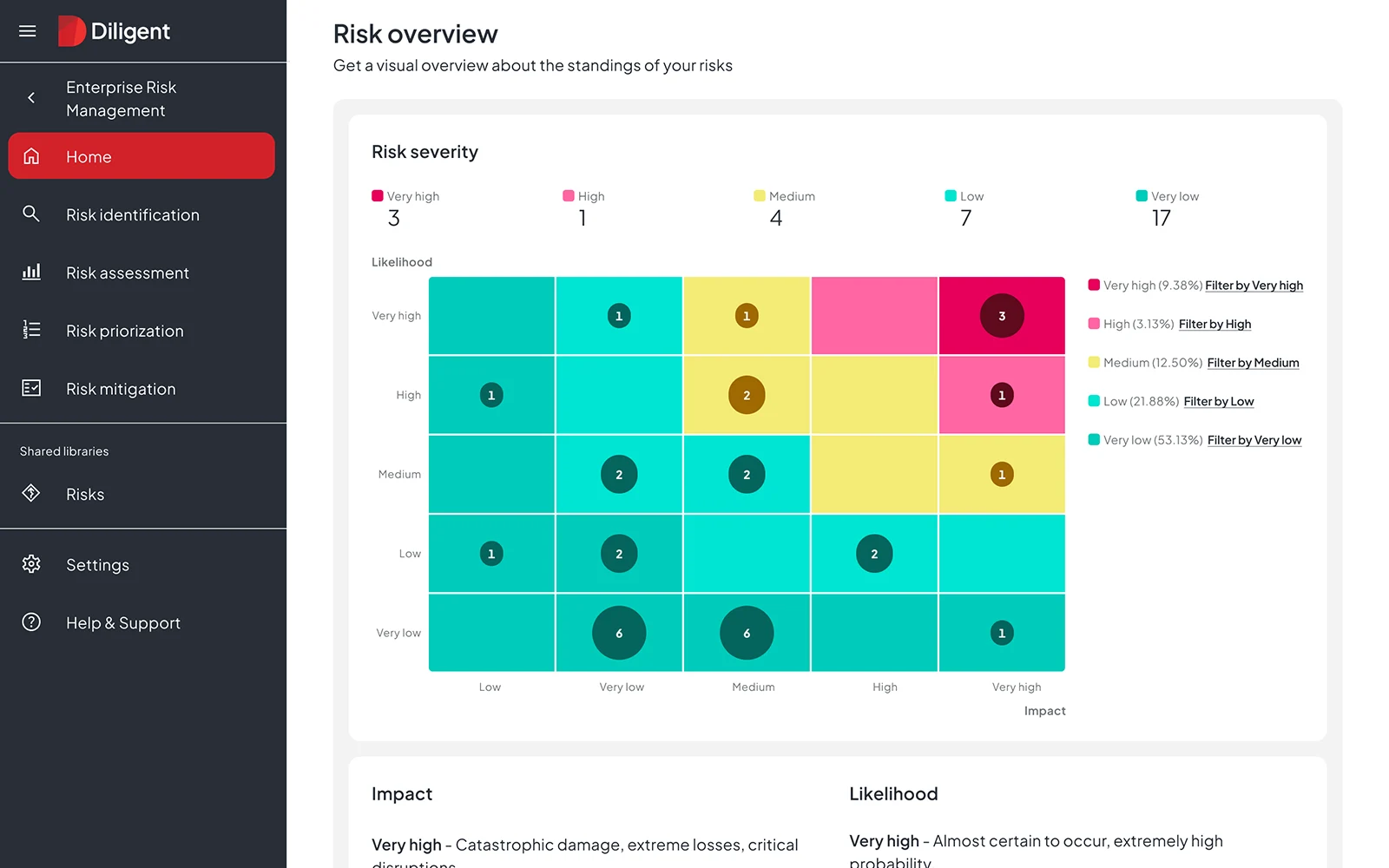
For organizations building a program under resource constraints, AI Risk Essentials delivers AI-powered peer benchmarking and training that accelerate maturity in as little as seven days — a practical path to professional AI governance without hiring consultants or building frameworks from scratch.
Diligent IT Compliance accelerates the certifications and frameworks that underpin AI governance. Pre-built framework toolkits support 75+ frameworks, including ISO/IEC 42001, NIST AI RMF, SOC 2 and ISO 27001, so teams don't build AI governance documentation from scratch. AI control suggestions help teams without dedicated compliance expertise implement requirements quickly, with a Common Controls Framework that enables reuse across certifications, and automated evidence collection streamlines external audits — demonstrating maturity to regulators, investors and customers.
Together these capabilities move AI governance from policy documents to operational reality. Book a demo to see how Diligent helps organizations transform their AI governance processes.
AI governance is a shared responsibility. A chief compliance officer, general counsel or dedicated AI governance team typically provides oversight, while the board retains ultimate accountability. Chief technology officers lead technical governance, chief risk officers run risk assessments and legal counsel ensures regulatory compliance — and all employees share responsibility through training and policy adherence.
AI governance is the broader discipline: policies, oversight, accountability, ethics, regulatory alignment and board reporting. AI risk management is one component inside it, focused on identifying, assessing and treating risks tied to AI systems (bias, drift, security, third-party AI, regulatory exposure). A working program needs both; risk management without governance lacks the accountability structure to make decisions stick.
The NIST AI Risk Management Framework provides voluntary guidance through four functions — govern, map, measure and manage. ISO/IEC standards like ISO/IEC 42001 provide certifiable management-system requirements that organizations can use to demonstrate maturity through third-party audits. Many organizations layer both, using NIST for risk methodology and ISO for certification-ready governance structures.
The EU AI Act requires organizations to classify AI systems by risk level and apply governance proportionate to that risk. High-risk systems require conformity assessments, technical documentation, human oversight and incident reporting. Organizations operating in EU markets or serving EU customers must align with these requirements or face significant penalties.
Internal audit is the third line of defense. It provides independent assurance to the audit committee that the program is designed and operating effectively — auditing inventory completeness, testing controls, reviewing policy compliance and tracking remediation. It does not own the program; it audits whether the first and second lines are running it properly.
Boards should ask about the AI inventory, how systems are classified by risk, what controls exist for high-risk applications, how incidents are detected and reported, the compliance roadmap for applicable regulations and who holds accountability for outcomes. Regular AI governance updates should be a standing board agenda item.
Ready to move AI governance from policy to program? Schedule a demo to see how Diligent operationalizes AI governance across board, risk, compliance and audit.

Using AI for enhanced decision-making: 9 innovative ways to boost board efficiency and effectiveness

After grappling with artificial intelligence from a governance perspective, have you thought about using this transformative technology in your own daily activities — automation to streamline administrative tasks, AI to facilitate better decision-making and so forth?