
In this article

For CFOs and corporate secretaries at growing companies, choosing a Google Slides investor pitch deck template is only the first step. The contributions still have to be coordinated across leadership, finance and legal. Your CEO wants to rework the vision slide, while counsel and the finance team keep the market language and traction numbers aligned with the underlying model. All of this happens across email threads and shared drives, with three versions circulating and no clear answer to a simple question: which file is the real one?
That coordination problem is why the template you choose matters more than most teams assume. It sets the structure, but the workflow around it determines whether institutional investors see a polished, coherent story or a document that quietly contradicts itself. That gap is a due diligence risk.
This guide covers:
Your pitch deck template is the first thing that tells an investor how you operate. Institutional investors review hundreds of decks, and they form judgments quickly. Because investors spend an average of just two minutes and 42 seconds with a deck, according to DocSend/Dropbox data, every slide should earn the next moment of attention rather than assuming a full read.
That compression changes how you should think about template choice. A cluttered layout or inconsistent formatting, including fonts that render differently across devices, costs you attention you cannot spare. Template choice and collaboration structure matter beyond aesthetics because they determine whether your investor presentation in Google Slides reads as coherent under a quick skim, and whether the numbers on your traction slide match the financial model your CFO maintains separately.
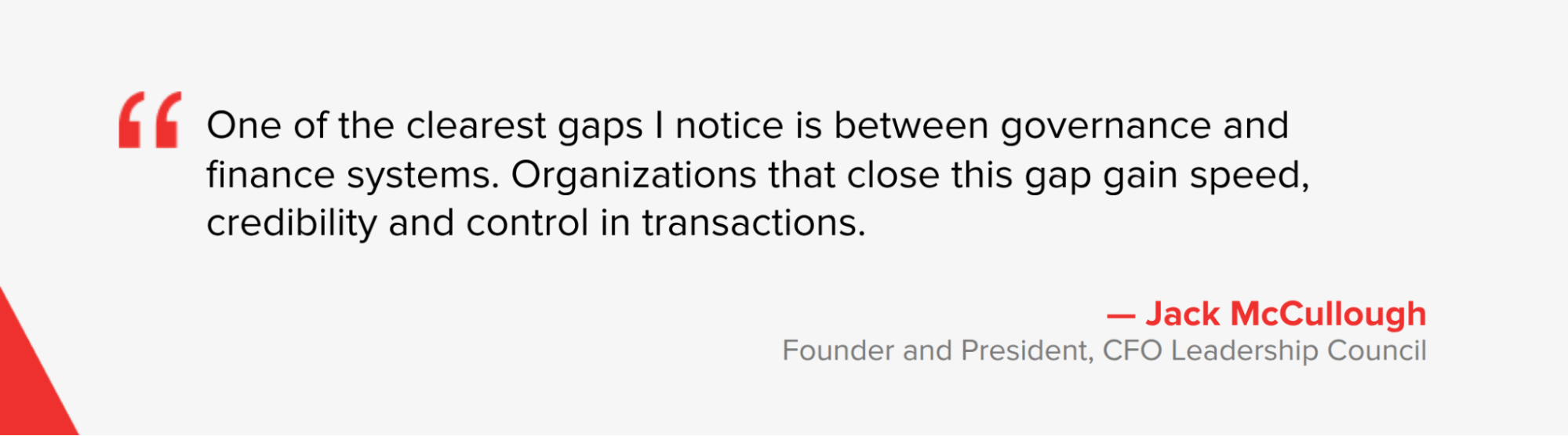
For finance and governance leaders, there is a second signal at work. The deck presents your company, but institutional investors also assess the infrastructure behind it during due diligence. When the pitch is the most polished document in the process and the board records and data room are disorganized, that contrast raises questions about governance maturity, and it's a pattern Jack McCullough, Founder and President of CFO Leadership Council, sees often enough to name directly: "One of the clearest gaps I notice is between governance and finance systems. Organizations that close this gap gain speed, credibility and control in transactions."
That expectation extends to the boardroom itself. Diligent Institute's What Directors Think 2026 report found that 58% of directors want more time for strategic discussion and fewer presentations, the same premium on clarity and preparation that governs how investors read a pitch deck.
The pitch deck is usually the first place that gap becomes visible to someone outside the company, which is exactly why it can't be the only polished document in the room.
That gap is exactly what a coordinated deck-and-governance approach closes. Building governance infrastructure ahead of a raise, rather than assembling it under pressure once investors start asking, is what separates teams that clear diligence quickly from those that stall.
Several frameworks frequently shape pitch deck structure. Understanding them lets you vet any startup pitch deck template against a proven narrative rather than accepting whatever slide order a designer chose. Whether you are building an angel investor pitch deck or a Series A deck, matching your opening logic to your investor and stage is the difference between holding attention and losing it early.
The Sequoia pitch deck template follows a compact sequence: company purpose, problem, answer, why now, market potential, competition, business model, team, financials and vision.
Its distinguishing feature is the early "why now" slide, and it bookends company purpose with vision, a structure the other frameworks lack.
The Y Combinator pitch deck for seed rounds recommends a structured deck that opens with a title slide, then moves to vision, problem, customer, product, market, market context, traction, business model and team, before closing with a summary and a fundraising slide.
The seed round pitch deck has a dedicated customer slide and an explicit fundraising slide. It puts proof before theory by surfacing traction ahead of market sizing.
For Series A, YC's Series A guide advises a concise main deck, typically 10 to 15 slides, with appendix material kept separate. A Series A pitch deck leads with revenue. Traction appears twice: as an early teaser and again in depth. The use of funds slide is the climax.
The Guy Kawasaki pitch deck rule is built around constraints on slide count, meeting length and typography. A pitch should focus on a limited number of concepts an audience can actually absorb in a meeting.
It is the only framework that specifies constraints on time and typography, and the only one with dedicated underlying magic and go-to-market slides alongside an explicit call to action as the close.
Together, these frameworks give finance and governance leaders a practical test for templates: if the slide order does not support the investor's decision process, the design polish will not compensate.
For companies already building toward a public listing, that same governance discipline extends beyond the fundraising deck. Teams that start building governance infrastructure well before a public offering find these fundraising frameworks easier to sustain under investor and diligence scrutiny alike.
Discover how AI transforms board preparation and decision-making for growing companies.

Not every template that claims Google Slides compatibility works natively. For multi-stakeholder teams, native Google Slides matters because it eliminates the conversion friction and font substitution that break decks when they pass through PowerPoint or a proprietary platform. Here are the free and paid VC pitch deck template options ranked with that workflow reality in mind.
For a finance-led fundraising process, choose the template that preserves collaboration, chart accuracy and version control over the one with the most dramatic design.
A note on Canva pitch deck vs Google Slides: there is no lossless path from Canva to Google Slides. During import, charts, SmartArt, 3D objects and WordArt are ignored, which alone is a serious limitation for a finance team that lives in charts.
Once you have a template, Google Slides for fundraising works because of the collaboration features underneath it. These collaboration tools directly address the pitch deck version control chaos of coordinating a CEO, CFO, legal counsel and advisors on one live document.
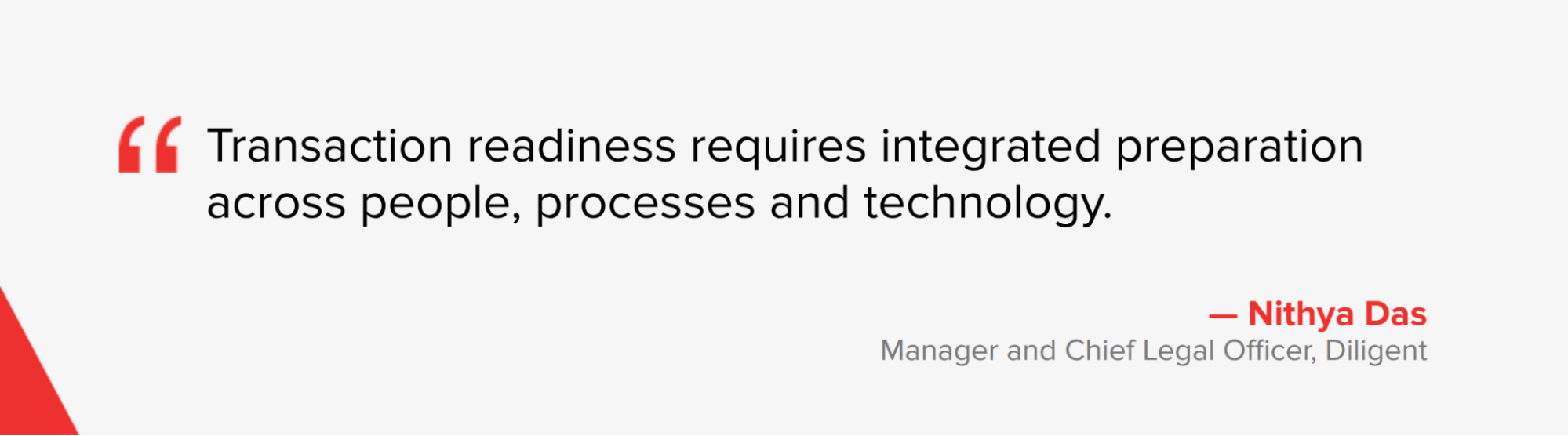
These features solve the mechanical half of the problem: who can edit what, and which version is real. The harder half is making sure people, process and technology actually move together, which is the distinction Nithya Das, Manager and Chief Legal Officer at Diligent, draws when she talks about what transaction readiness really requires: "Transaction readiness requires integrated preparation across people, processes and technology." A shared Google Slides file with clean permissions still fails if the CFO's model, the CEO's narrative and counsel's risk language were never actually reconciled against each other.
Effective pitch deck templates for investors are built around how investors actually read, not how designers like to design. Treat your team and business model slides as headline assets. Lead with the credentials, track record, operating proof and unit economics that make your company the reason to believe.
DocSend/Dropbox data backs up that priority with real numbers: investors spend an average of 83 seconds on the business model section alone, and at the seed stage, team slide attention rose 40% year-over-year as investors prioritize the people behind the pitch over market context.
These principles follow from investor behavior:
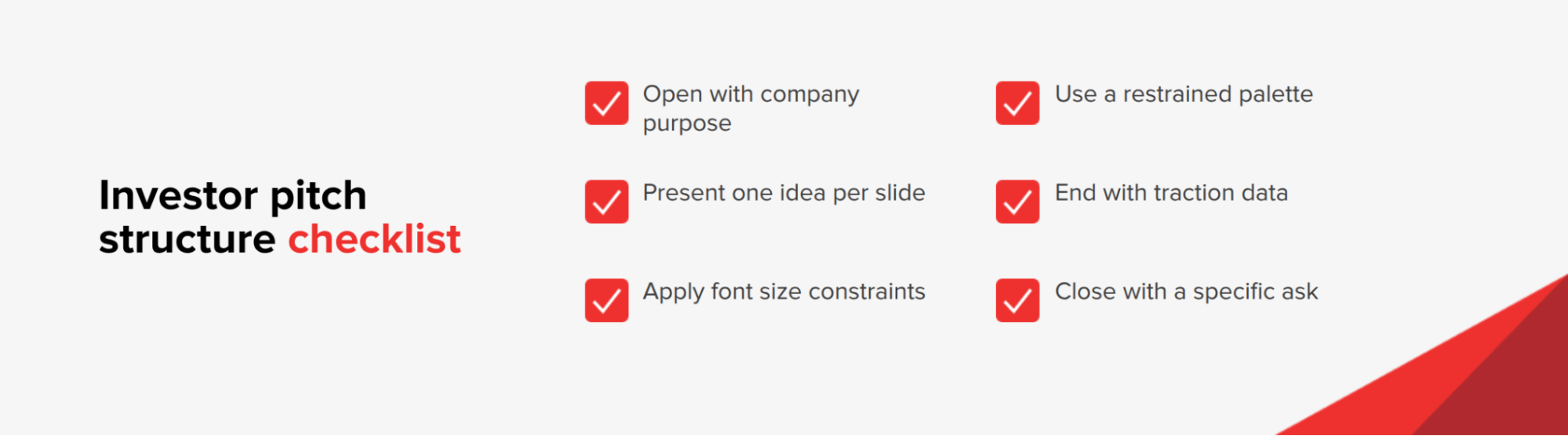
Every slide should make one investor judgment easier, whether that judgment concerns market timing, revenue quality, team credibility or use of funds, because investors are already inclined to hesitate before they even open your deck.
Rich Mullen, Partner at Wilson Sonsini, has watched that hesitation play out across dozens of transactions: "Economic uncertainty makes it very difficult for business leaders to make decisions. It leads to a higher probability of diverging views on valuations and fears of making the wrong decision." A deck with a confused narrative or mismatched numbers doesn't create that caution, but it gives investors one more reason to indulge it.
Coordinating contributors, maintaining version control and keeping investor materials aligned with your governance record are the same problems that surface, at higher stakes, when institutional investors open due diligence. According to the Transaction Readiness Report by Diligent Institute, Wilson Sonsini, NetSuite, CFO Alliance and CFO Leadership Council, 56% of organizations named limited resources as their top transaction challenge. For CFOs and corporate secretaries, map the deck, financial model, board approvals and data room to a single owner and review cadence before investor outreach begins. Treat governance infrastructure as an ongoing discipline, because the gaps investors flag during IPO preparation are the ones you cannot close in a scramble. Building that discipline early, rather than under pressure, is what separates genuine transaction readiness from improvising once investors start asking questions.
Most live pitches benefit from a concise core deck, typically 10 to 15 slides, over an overloaded data file that tries to answer every possible question upfront. This range fits Series A through C fundraising; earlier-stage decks, such as angel rounds, typically call for a shorter core deck. Keep the main narrative focused on the story an investor needs to make a first-meeting decision, then use an appendix for detailed backup such as cohort data, financial model detail and supporting market analysis. A deck padded with every available data point signals uncertainty about what actually matters to your story.
Google Slides fits collaborative, multi-stakeholder decks where real-time co-editing, comment threads and version control matter most, which is typically the case when a CEO, CFO and legal counsel are all contributing. PowerPoint remains the industry standard for high-stakes, data-heavy decks needing offline reliability and tighter design control, particularly at later stages or in regions where PowerPoint is the default investor format. Many finance teams use Google Slides for drafting and collaboration, then export to PDF for final distribution.
Team slides and financial or business model sections consistently draw the most attention. with DocSend data showing meaningful time spent on both relative to the rest of the deck. DocSend/Dropbox data shows investors spend an average of 83 seconds on the business model section, and seed-stage team slide attention rose 40% year-over-year as investors prioritize founding teams. Invest disproportionate preparation in these slides, and make sure the numbers align with your underlying financial model rather than a simplified version built just for the deck. A traction number on the pitch slide that does not match the board-approved model is one of the fastest ways to lose investor confidence during diligence.
For Series A through C, the appendix is a due diligence repository for cohort retention data, LTV and CAC detail, full financials, founder bios and a competitive moat analysis, while the main deck stays focused on the core narrative. Keeping this material in a well-organized appendix, rather than crowding it into the main deck, lets you answer follow-up questions quickly without diluting the story you lead with in the first meeting.
You can, but there is no lossless path, since fonts get substituted, animations are lost and charts, SmartArt, 3D objects and WordArt are ignored on import. For a finance-heavy deck where chart accuracy matters, start in a native Google Slides template instead of importing from Canva, so your traction and financial slides render exactly as built rather than degrading during conversion.
Ready to build governance infrastructure that supports your next funding round? Schedule a demo to see Diligent in action.