

This article originally appeared in our June 4th edition of the Diligent Minute Newsletter. For more insights like these, delivered straight to your inbox, subscribe here.
At this year’s Elevate Leadership Summit, one idea surfaced repeatedly across conversations on AI, succession, M&A, compensation and geopolitics: the old model of episodic oversight is no longer enough. Boards are operating in an environment defined by rapid technological change, geopolitical volatility and rising expectations from every stakeholder group. The challenge isn’t a lack of information. It’s that governance itself hasn’t kept pace with how risk now shows up. In that context, governance cannot be treated as a quarterly ritual. It has to become a continuous discipline.
That shift starts with a more realistic understanding of what boards are being asked to oversee. AI is not a side topic for the technology committee. Geopolitics is not an annual presentation slide. Succession planning is not a once-a-year checklist. Each is now deeply interconnected with strategy, talent, culture and long-term value creation. As Joe Hurd, independent director at Lloyd’s, Hays and Trust Pilot puts it, “Every company is a technology company, every board is now a succession board, and every director is now a geopolitical actor.” This isn’t about adding more to the agenda. It’s about recognizing that everything is already connected.
What does that mean in practice? First, boards need to stop treating AI fluency as a niche specialty. The Summit’s speakers were clear that one resident “AI expert” is not enough; the full board needs enough understanding to ask better questions, challenge assumptions and connect AI decisions to enterprise risk and business strategy. When AI-driven decisions surface in the boardroom, every director needs to engage with confidence — not defer. As Jean Harvey-Johnson, VP of AI Enablement & Process Optimization at Fiserv says, “AI governance is not a future-facing topic, it is a present-day board responsibility.”
Second, boards need to rethink how they approach leadership readiness. Succession came up repeatedly at Elevate not as a talent-management exercise, but as a core governance capability. In a volatile environment, boards cannot afford to confuse a list of names with a real plan, nor can they wait for a crisis to test the strength of the pipeline. Succession only proves itself under pressure — not on paper. Mary Lee Sharp, founder and board advisor at People First Advisors captured the urgency well: “AI fluency now belongs on every executive and CEO succession profile right alongside the traditional readiness competencies boards have always valued.”
Third, continuous governance requires a stronger human foundation. Several discussions returned to the importance of trust, presence and culture in board effectiveness, especially as decisions grow more complex and consequences more far-reaching. When decisions happen faster and with less certainty, how directors engage with each other matters as much as the information in front of them. The message was simple but profound: Good governance is not just about structure and process. It is also about whether the people around the table can learn quickly, listen well and challenge each other productively.
Boards do not need to predict every disruption. But they do need to build the habits, fluency and courage to govern through them continuously. That means making succession, AI and geopolitics standing agenda items; refreshing board composition for the future; and investing in learning as a permanent feature of governance, not a periodic add-on. The shift to continuous governance is already underway; the opportunity now is to keep pace.
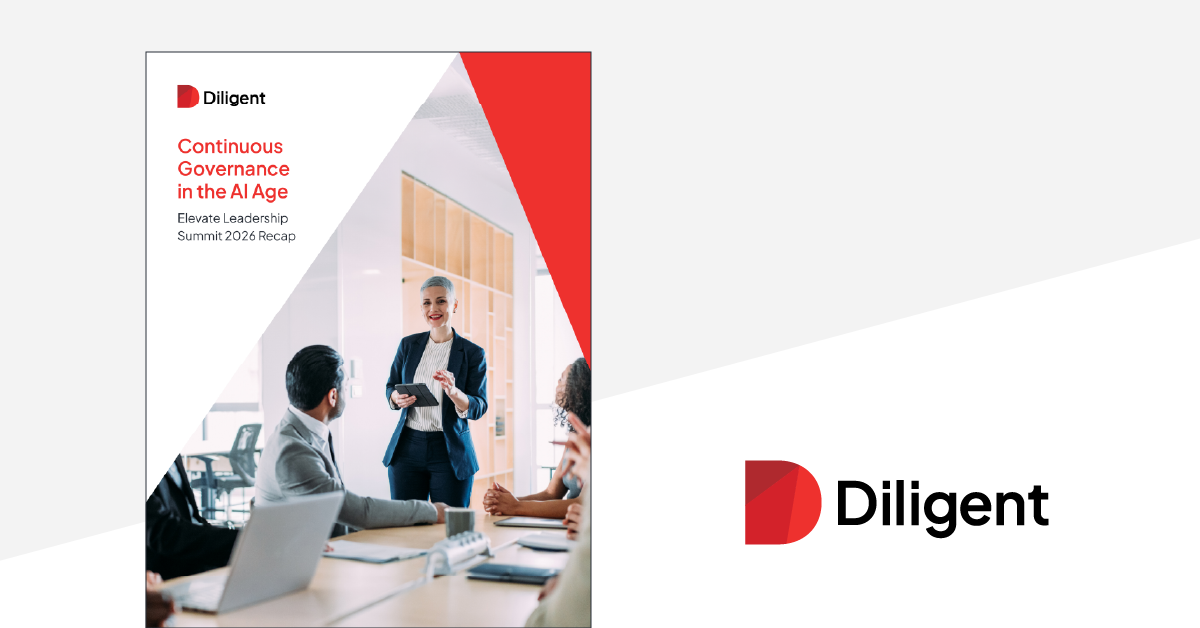
Continuous Governance in the AI Age: Elevate Leadership Summit 2026 Recap
At the 2026 Elevate Leadership Summit, directors, C-suite leaders, and governance experts came together to examine what effective board leadership looks like now. Across conversations on M&A, succession, executive compensation, AI governance, geopolitics, and board culture, one message came through clearly: governance can no longer be episodic. It must be continuous, integrated, and future-focused.

Moving to continuous governance and risk oversight

In this episode of The Corporate Director Podcast, guest Joe Hurd explains why boards can no longer rely on quarterly geopolitical risk reviews in an era of poly-crisis—where multiple shocks unfold simultaneously across regions and risk categories. Drawing on his cross-sector board experience and public service background, Joe lays out how directors can move toward continuous risk oversight, build compound scenarios that integrate geopolitics, and use AI thoughtfully in the boardroom while avoiding legal and governance pitfalls.