
In this article

For general counsel evaluating the best AI legal analysis tools, the selection process looks nothing like the one law firms or solo practitioners face. You carry fiduciary obligations, confidentiality duties and board-reporting responsibilities that make every technology decision a governance decision.
A single leak of privileged board materials or M&A deliberation through an unsecured AI tool is not a billable write-off. It is the kind of incident that ends careers. This article is a governance-first buyer's guide. A tool that cannot be governed is not a tool a general counsel can defend to the board.
This guide covers:
AI legal analysis tools apply machine learning, natural language processing and generative AI to legal work. Research, contract review, matter management, e-discovery and compliance monitoring all benefit, enabling general counsel to produce defensible output faster and at lower cost.
What distinguishes a legal AI tool from a generic chatbot is the underlying architecture: retrieval-augmented generation against verified legal sources, visible citations on every output, enterprise security controls and audit logs. For in-house teams, these are not nice-to-haves. They are the difference between a tool that can be defended in an audit committee briefing and one that cannot.
Those concerns are already showing up in enterprise risk profiles. According to the GC Risk Index, AI-related risks appear in nearly four in ten responses when legal leaders are asked what most influences their assessment of organizational risk, placing AI alongside cyber risk as a top-tier governance issue.
Five categories cover the bulk of enterprise legal AI work today:
These categories overlap in practice, and most enterprise legal departments will eventually use tools from more than one. The goal is best-in-category tools connected through a governance layer the board can see into, not a single vendor that does everything poorly.
Generic AI assistants can hallucinate citations, and using them may create risks around prompt retention, privilege and auditability. GC-grade platforms ground outputs in verified legal databases, enforce enterprise security controls and log every interaction.
Four differences matter most for in-house counsel:
A vendor that cannot clear all four of these thresholds is a consumer tool dressed in enterprise marketing.
General counsel carry fiduciary and confidentiality duties that law firms distribute across clients. A GC answers to a board, not a billing partner. Tool selection has to be defensible in governance and audit reviews, not just efficient.
Three pressures make in-house evaluation structurally different.
Confidentiality at enterprise scale: Any AI tool that processes data outside the enterprise perimeter introduces liability. Publicly available AI platforms can create privilege risk when sensitive information is submitted to them. That makes contractual data isolation a binary threshold, not a preference.
Board and audit committee reportability: As AI governance expectations grow, governance documentation becomes increasingly important. That gap matters for general counsel, because a legal-tech buying decision increasingly has to stand up to board scrutiny even where formal governance is still catching up.
Budget pressure combined with rising workload: General counsel must reduce outside-counsel spend and absorb more regulatory tracking without growing headcount. AI tools promise efficiency, but the wrong tool creates more governance risk than it saves.
These pressures push general counsel toward a more structured evaluation approach than feature comparison alone.
Before scoring any product, score the evaluation criteria. This framework governs every tool category discussed below.
Accuracy and source citation: Require retrieval-augmented generation against verified legal databases, visible citations on every output and documented hallucination controls. Ask vendors for specific hallucination-control documentation, not marketing claims.
Data security and confidentiality: Require security certifications, zero-data-retention commitments, data residency options and contractual language confirming the vendor does not train on your inputs.
Defensibility and audit trail: Every AI interaction needs logging: who accessed what, when and under whose authority. Version control and prompt-and-output logging for regulatory inquiries are non-negotiable for public companies subject to SOX controls.
Integration with legal and GRC stack: The tool must connect to your document management system, CLM, enterprise legal management platform, e-discovery environment and board portal. Integration gaps are common: according to the Transaction Readiness Report by Diligent Institute and its research partners (Wilson Sonsini, NetSuite, CFO Alliance and CFO Leadership Council), only 4% of organizations have fully integrated GRC and financial systems.
Total cost of ownership: Evaluate per-seat licensing versus matter-based pricing, implementation cost and training time. A tool that clears the budget test but fails the governance test creates hidden costs, including legal exposure, audit findings and rework, that eclipse the license savings.
AI governance and regulatory alignment: Evaluate vendor alignment with the EU AI Act and emerging AI laws. According to What Directors Think 2026 by Diligent Institute and Corporate Board Member, 50% of directors say AI and technology-related regulation will demand the greatest board attention in 2026.
Human-in-the-loop controls: Configurable review gates, approval workflows and explainability of outputs that support AI governance at scale. Delegating final sign-off to AI output can expose directors to duty-of-care claims, which is why most enterprise deployments require human review at every publication gate.
“Have a candid assessment of what your board's capabilities are… The board needs to apply an appropriate level of governance pressure to someone who's going to oversee the AI landscape, the risk exposure, the disruption and the opportunity.”
— Keith Enright, VP and Chief Privacy Officer at Google and Board Director at ZoomInfo
See how governance teams oversee legal-tech AI adoption with audit-ready documentation.

The strongest buying decision is usually category-first, not vendor-first. Start with the use case creating the most pressure inside your department, then test whether available platforms meet the governance criteria above.
Smart Legal Scanner is an AI content type within Diligent GovernAI, designed specifically for general counsel and legal teams reviewing board packs. It scans uploaded board books and decks to identify potentially risky legal language, sensitive topics and sections that may increase legal exposure, so issues can be addressed before distribution rather than surfaced in the meeting.
It flags legal risk indicators and content that may warrant further review by legal or compliance teams, functioning as the legal-focused AI content type within GovernAI and complementing Smart Risk Scanner and SmartPrep.
Best for: Governance-layer AI for legal teams reviewing board and committee materials.
Less suitable for: Teams whose primary need is open-ended legal research, contract redlining or e-discovery, where a matter-level tool is the better fit.
CoCounsel pairs generative AI with Thomson Reuters' proprietary content, including Westlaw Precision and Practical Law, to handle case law research, brief review, contract analysis, deposition preparation and summarization.
Answers come grounded in primary law and editorial commentary, which gives general counsel citations they can defend in a board memo or a regulatory filing. The Westlaw grounding is the main draw for in-house teams that need research output to stand up to audit committee questioning.
Best for: Legal research platforms.
Less suitable for: Lean legal departments without existing Thomson Reuters subscriptions or the budget to support enterprise-grade legal content access.
Ironclad is a full contract lifecycle management platform with AI Assistant and AI Playbooks built in, auto-tagging clauses across large contract repositories, applying playbook-driven review to flag deviations and summarizing key terms for business stakeholders.
The CLM-native approach is the structural advantage for general counsel standardizing review across commercial, procurement and employment contracts at scale. Spellbook and LexCheck compete on specific workflows, but Ironclad's breadth wins when the goal is one platform across contract types.
Best for: AI contract analysis and drafting platforms.
Less suitable for: Small legal teams without the contract volume to justify a full CLM deployment.
Streamline AI is built specifically for in-house teams, with self-service intake forms that route requests and auto-classify matters, AI that suggests matter type and risk profile, and dashboards that track volume, turnaround time and workload. It gives general counsel the quantitative picture they need for resourcing conversations and board-level legal operations reporting. iManage and GC AI compete on adjacent ground, but Streamline's intake-first design is purpose-built for the GC workflow.
Best for: AI matter and legal operations management platforms.
Less suitable for: Organizations with limited outside-counsel spend or low matter volume, where the automation benefits may not justify implementation effort.
Everlaw is a cloud-native e-discovery platform that supports predictive coding, automated clustering, email threading and near-duplicate detection, with generative features for summarizing key documents and building timelines. Relativity remains the enterprise-scale standard and Lex Machina owns the litigation analytics niche, but Everlaw's combination of AI-powered review and native summarization gives general counsel the clearest path to reducing outside-counsel review spend on litigation and investigations.
Best for: AI e-discovery and litigation analytics platforms.
Less suitable for: Organizations with strict on-premise data residency requirements that cannot accommodate a cloud-native platform.
LexisNexis Regulatory Compliance tracks regulatory developments across federal, state and international jurisdictions, combining proprietary content with AI-driven alerts that surface the changes most relevant to each subscriber.
It maps rules to plain-English explanations and links obligations to the underlying primary sources, so compliance teams can move from alert to action without re-researching the regulatory basis. For legal departments that already run on Lexis content for research, the platform also integrates with Lexis+ AI, which reduces switching cost between regulatory monitoring and legal research workflows.
Best for: Legal departments standardized on LexisNexis content that want AI compliance monitoring connected to their research stack.
Less suitable for: Organizations without an existing Lexis subscription, where the integration advantage does not apply.
Six decision factors determine which tool category deserves your first investment:
“Trust is the number one thing. Once you have trust that the executive teams believe in the data, believe in the risk you are identifying, then you can have fulsome conversations, you can create change.”
— Tom Keaton, Vice President, Business and Product Strategy at Diligent
The internal baseline comes first. Audit your department's defensibility posture, confidentiality controls and integration debt, and let that assessment shape which tool category gets evaluated next.
General counsel serve as the oversight layer for AI adoption across the organization. Five practices turn AI adoption from a scattered experiment into a defensible program:
Build an AI inventory before your next committee briefing, and report regularly on tools deployed, risks identified and training delivered. Use that inventory to identify shadow adoption and to decide where approval controls or training need to tighten first.
Inventory is only the starting point. Assign ownership for review, standardize how legal documents AI use across matters and departments, and clarify reporting lines before the next board or audit discussion.
“Put AI in your risk register. No one's going to argue with that. Get an AI policy. Board should be asking management for a policy.”
— Richard Barber, CEO of MindTech Group
The tools above solve matter-level and compliance-level problems. They don't give general counsel the board-reporting and audit-trail layer that makes AI adoption defensible across the organization. That's the gap Diligent's governance platform fills.
For general counsel reporting on legal-tech AI adoption to the audit committee, Diligent Boards brings board-ready reporting and secure oversight into one environment. GovernAI capabilities synthesize AI adoption updates into board materials, while Smart Builder, SmartPrep and Smart Risk Scanner help legal and governance teams prepare clearer materials, surface legal and compliance risks earlier and generate more focused discussion prompts for directors.
For enterprise and public company general counsel, AI adoption sits inside the enterprise risk register. Diligent enterprise risk management capabilities place AI-related legal and regulatory risks alongside cyber, third-party and operational risks in a single register. Regulatory Compliance Management maps new requirements to existing controls so the legal department stays ahead of enforcement deadlines.
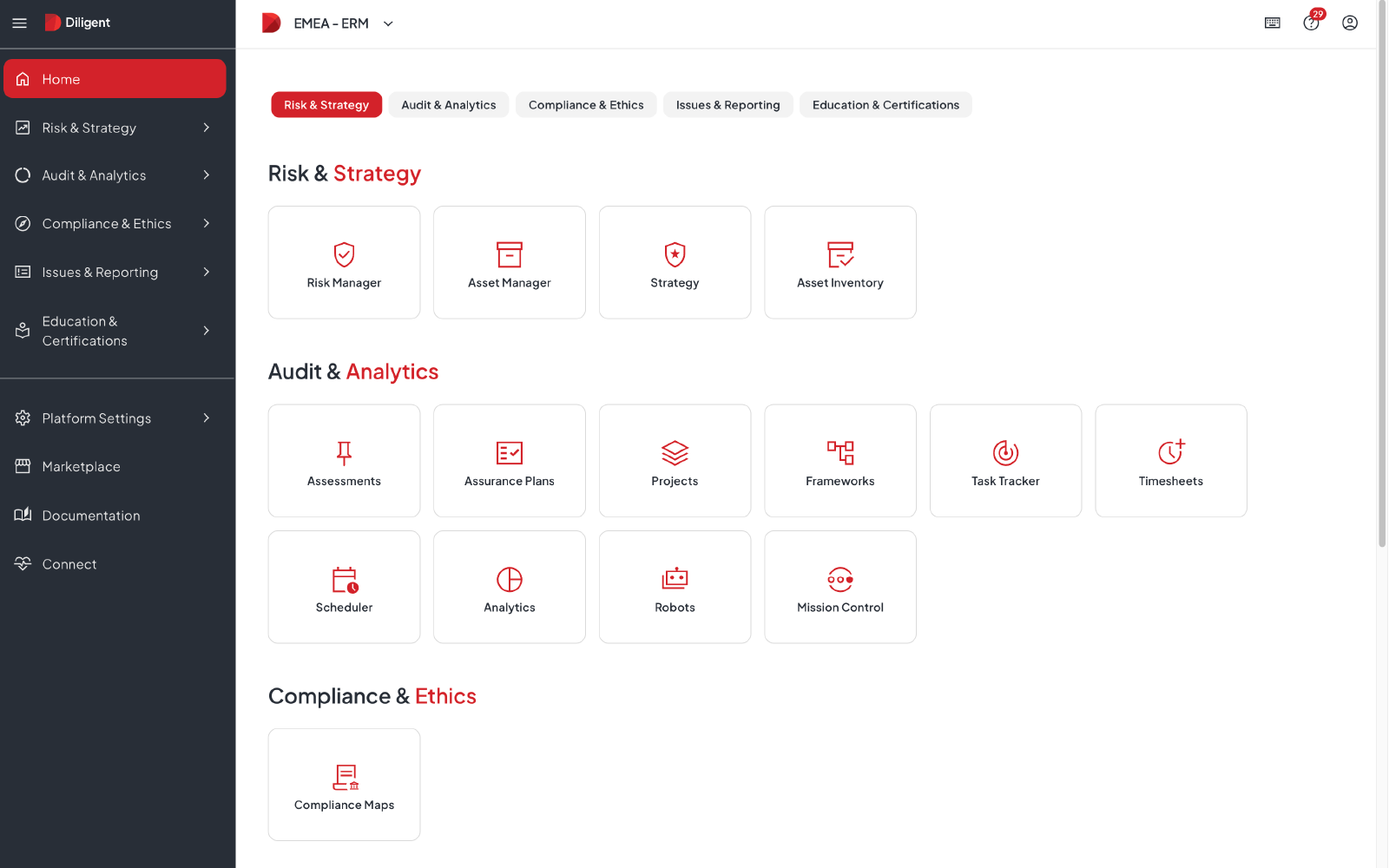
Diligent Policy Manager rounds out the governance layer with automated attestations, version-controlled audit trails and centralized policy distribution. For general counsel maintaining AI-use policies across departments, Diligent Policy Manager creates the documentation trail auditors and regulators expect.
Together, these capabilities connect AI governance data to board materials, risk dashboards and audit reports through the Diligent One Platform, reducing manual reconciliation across governance workflows.
The best AI legal analysis tools for general counsel in 2026 combine grounded research, clause-level accuracy, matter visibility and regulatory speed with the confidentiality and audit controls enterprise deployments require. But the difference between a department that runs AI as a collection of point tools and one that runs it as a defensible governance program comes down to oversight: How consistently AI use is inventoried, how rigorously human-in-the-loop controls are enforced and how transparently AI adoption is reported to the board.
For the general counsel who owns this process, the operational reality is demanding. AI-use policies need to be current and attested to, regulatory changes need to map to existing controls within days rather than weeks, and board materials need a defensible review pass before they leave the department. When these elements break down, the consequences show up as privilege risks in unsecured AI tools, compliance gaps that surface during audit and AI governance questions from directors that legal cannot answer on the spot.
The framework in this guide, from the governance-first evaluation criteria to AI policy and board reporting, gives legal departments the discipline to adopt AI without losing control of it. Technology closes the remaining gap by connecting AI governance data to the risk registers, compliance workflows and board reporting that auditors and regulators expect to see.
Strengthen governance around AI legal tools. Schedule a demo to see how Diligent connects legal, risk and board reporting on a single platform that keeps AI adoption defensible across the organization.
Leading options include Diligent GovernAI (Smart Legal Scanner) for legal risk review of board materials, Thomson Reuters CoCounsel for legal research, Ironclad for contract analysis, Streamline AI for matter management, Everlaw for e-discovery and Thomson Reuters Regulatory Intelligence for regulatory monitoring. Evaluate each against the governance-first criteria of accuracy, confidentiality, defensibility and oversight rather than starting with brand recognition.
In-house counsel face confidentiality requirements, integration demands and board-reporting obligations that law firms do not. A GC must ensure any AI tool generates documentation auditable by external auditors under SOX controls.
Require established security certifications, zero-data-retention commitments and data residency options. Contractual language should confirm the vendor does not train on your inputs.
Report regularly on the inventory of AI tools in use, AI-use policy status, training delivered to staff, incidents or risks identified and relevant regulatory changes. Make it a standing audit committee agenda item.
AI-generated legal work product requires human-in-the-loop review to be defensible. Treat AI output as a first draft requiring attorney validation, not a finished product.
Strengthen governance around AI legal tools. Schedule a demo to see how Diligent supports board reporting, risk and compliance.