
In this article

Boards receive more information than ever: management presentations, risk reports, ESG disclosures and market analyses. Yet more information alone doesn’t produce better decisions. Directors still struggle to separate signal from noise, and critical risks surface too late. The gap isn’t access to information. It’s the absence of structured, actionable governance insights designed specifically for fiduciary oversight.
According to What Directors Think 2026 by Diligent Institute and Corporate Board Member, 84% of directors have changed their approach to scenario planning, yet 53% say they don’t often receive real-time data between meetings. Meanwhile, 40% of boards don’t use AI at all for strategic oversight, even as deploying AI across the business ranks as a top priority. That disconnect between organizational AI adoption and board-level governance intelligence is where risk accumulates.
This guide explains how to close that gap:
Governance insights are a distinct category of decision-support intelligence that helps boards of directors fulfill their fiduciary duties through structured data, behavioral awareness and analytical frameworks. They differ from general business intelligence in three ways:
The distinction matters. Board governance insights emphasize qualitative, fiduciary, regulatory and long-term risk factors. Boards must move beyond intuition-driven deliberation to embrace analytics that improve board process and oversight.
Boards that structure their intelligence around these four categories spend less time sorting through information and more time acting on it.
This pillar covers director skills and diversity, tenure patterns, committee structures, engagement quality and performance evaluation. Start by mapping your board’s skills matrix against strategic priorities and identify gaps in emerging competencies like AI oversight and cybersecurity.
According to What Directors Think 2026, only 8% of boards report strong AI expertise, the lowest level across all areas surveyed. For boards overseeing enterprise AI adoption, that makes skills-matrix updates and explicit committee ownership of AI oversight an immediate governance priority.
Boards need real-time visibility into compliance obligations, regulatory changes, audit findings and remediation status. That means moving beyond management-curated quarterly updates to continuous monitoring.
What Directors Think 2026 also found that 39% of directors say technology-enabled compliance monitoring tools would improve oversight. If compliance reporting still depends on periodic manual updates, the board is likely seeing issues too late to respond effectively. Build a compliance dashboard that tracks incident rates and trends, audit findings with resolution timelines, regulatory compliance timeliness and third-party compliance status.
“AI creates risks and opportunities just like a thousand things you’ve dealt with before create risks and opportunities. In many ways you’ll use analogous skills: People, process, tech — training and awareness, set the tone from the top, the board should have a clear vision for AI, and it should be moving down throughout the org, you should have policies documenting what’s encouraged and what’s prohibited.”
— Keith Enright, VP and Chief Privacy Officer at Google and Board Director at ZoomInfo
The board’s role regarding ESG is oversight: developing accountability structures, internal processes and procedures. Key data elements include environmental metrics, human capital indicators, supply chain sustainability and climate risk analytics. Boards that embed ESG data into existing governance frameworks rather than treating it as a standalone reporting exercise gain a more integrated view of long-term risk.
This pillar provides integrated views of risk exposure, strategic execution and scenario analysis. According to the Q4 Business Risk Index by Diligent Institute and Corporate Board Member, business risk currently sits at 7.9 out of 10, up 16% since the start of 2025, and 44% of leaders say cross-function coordination needs improvement.
Ensure your management team develops a risk dashboard that aggregates key indicators from compliance metrics to market signals into a single view for enterprise risk management.
Leading boards are applying governance insights across every committee, shifting from retrospective review to forward-looking intelligence. In practice, the most effective boards are using data differently by function:
“Looking ahead, high performing boards will treat governance as a continuous discipline, built on real time data flows rather than periodic reports. And they will increasingly rely on integrated digital platforms, and over time, AI driven analytics, to surface patterns, flag emerging risks and point directors to where their judgment is needed most, while keeping human decision making firmly at the center.”
— Dottie Schindlinger, Executive Director, Diligent Institute
The practical takeaway is consistent: Use governance data and meeting-prep technology to compress presentation time and create more room on the agenda for decision-making, challenge and scenario discussion. Boards that use board portal technology to deliver unified pre-reads across committees spend less time aligning on facts and more time on implications, remediation priorities and disclosure decisions.
Learn how leading organizations strengthen oversight with better risk visibility, governance workflows and board reporting.

Turning governance intelligence from an aspiration into operating capability requires sequencing the work in clear phases:
Enterprise organizations with existing governance systems should formalize frameworks with documented processes and clear decision rights. Many organizations are formalizing board governance models and adding subcommittee specialization as complexity grows.
Move beyond the traditional balanced scorecard by adding predictive indicators, not just rearview-mirror metrics, to your board reporting. Boards today need indicators that help them anticipate, not just review.
The challenges documented above, fragmented committee intelligence, manual risk identification, inconsistent board materials and the widening gap between organizational AI adoption and board-level oversight, are exactly the problems an integrated governance platform like Diligent solves.
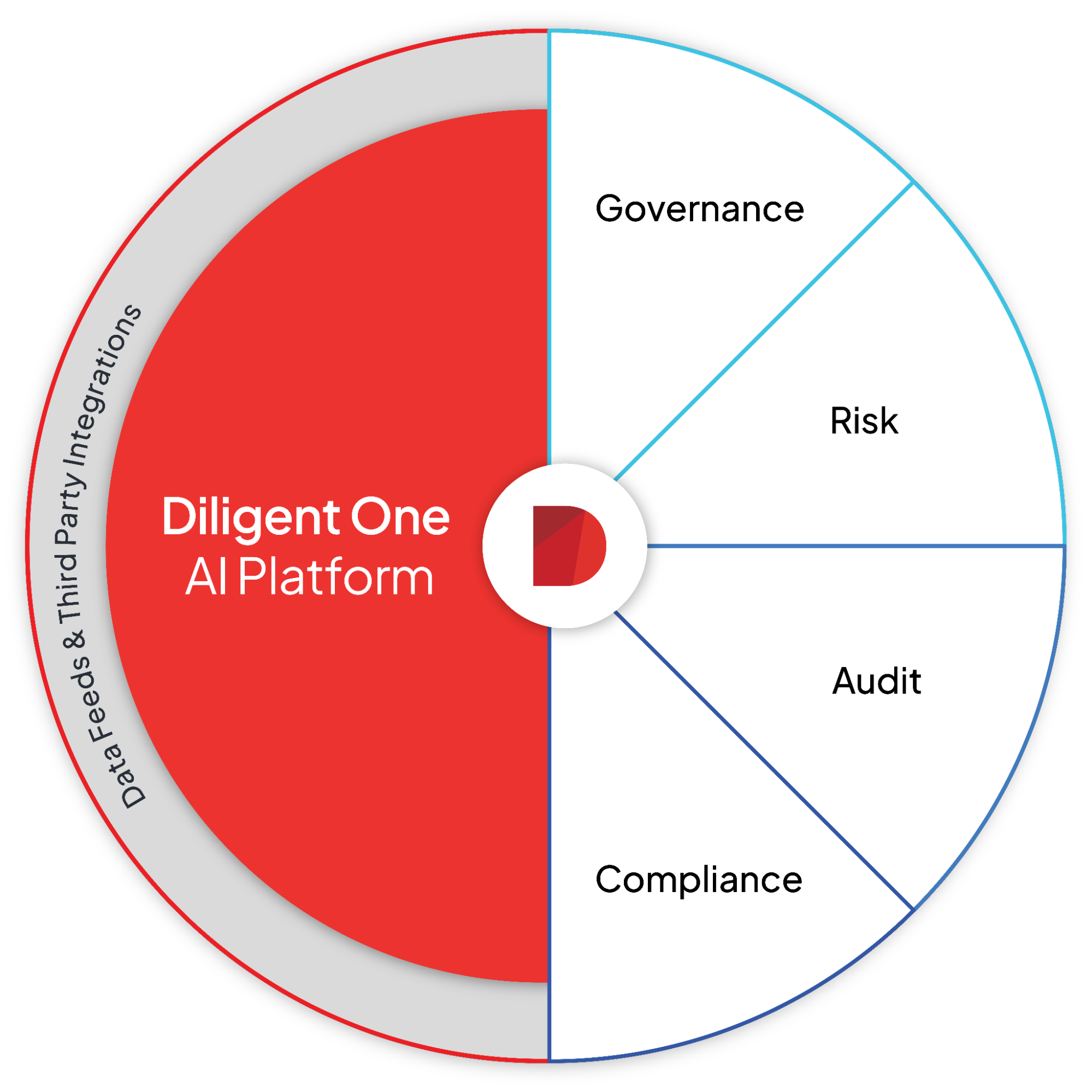
The operational benefit is straightforward: Governance teams spend less time assembling materials and more time validating information, coordinating across committees and supporting the higher-value board judgment that defines effective oversight. Boards that build governance intelligence infrastructure now position themselves to lead rather than react as risk complexity accelerates.
See how Diligent helps boards convert growing volumes of information into oversight that is faster, better grounded and easier to scale. Schedule a demo.
Begin by establishing data governance policies covering privacy, security, quality and ethical use before implementing any analytics. Assign C-level accountability, define governance KPIs from day one and integrate analytics into existing oversight processes rather than building them as separate workstreams.
Governance benchmarking means systematically comparing your board’s composition, processes and evaluation practices against peers. Key domains include structural comparisons (board size, committee design, independence ratios), process benchmarking (meeting cadence, material quality, evaluation rigor) and capability assessments covering technology maturity and AI readiness.
Boards are moving from AI education and awareness to integrated AI governance. Specific obligations include aligning AI with data governance standards and risk frameworks, requiring adequate infrastructure investment, using AI to strengthen compliance monitoring proactively and ensuring technology strategy aligns with organizational purpose and values.
Effective measurement covers systematic evaluations at board, committee and individual levels with third-party facilitation for objectivity. The critical question is whether your evaluations produce actionable insight or just compliance documentation. Focus on whether measurement drives specific changes in board behavior, committee focus and director development rather than generating reports that sit unused.
Several trends stand out: Stronger focus on strategy execution with 58% of directors wanting more strategic planning time, rising expectations for AI oversight as only 8% of boards report strong AI expertise, greater use of predictive KPIs beyond traditional balanced scorecards, and more agile oversight practices as boards respond to economic uncertainty and faster-moving risks. The shift from periodic reporting to continuous governance intelligence underpins all four.
Build governance intelligence infrastructure that scales with your organization. Schedule a demo to see Diligent in action.