

How much of your organization's activity does internal audit actually examine? If you're using sample-based testing, the honest answer is a fraction. The larger piece of the fraction operates without oversight until external auditors, regulators or fraud detection forces a closer look.
Manual testing can't review 100% of transactions in a reasonable time frame. So you sample, document your methodology and hope the tiny fraction you examine represents the larger slice you don't.
Audit committees question this approach. They expect continuous risk intelligence, not periodic sampling assurance. The problem: 78% of chief audit executives identify data analytics as their most critical skill gap, according to The Institute of Internal Auditors' 2025 North American Pulse of Internal Audit. Most teams lack the capabilities to close the gap between what committees expect and what traditional processes deliver.
Internal audit process automation addresses this gap. It transforms how audit teams work by automating routine surveillance tasks, enabling 100% data coverage instead of sampling, and freeing skilled auditors to focus on strategic risk analysis rather than evidence gathering. The result is an audit function that delivers continuous risk intelligence to support executive decision-making.
This guide explains how chief audit executives (CAEs) can implement internal audit process automation to transform their functions from periodic assurance activities into strategic business advisors:
Internal audit process automation uses AI-powered technology to automate the workflows, testing procedures and reporting activities that audit teams perform. It transforms how auditors conduct their work rather than automating the business processes they review.
This distinction matters. Automated internal controls are system-enforced guardrails built into business operations, like three-way matching in accounts payable, segregation of duties in ERP systems and automated reconciliations. These controls prevent or detect errors within business processes themselves.
Internal audit process automation gives auditors better tools to evaluate those controls and the broader risk environment. It includes:
Consider a typical accounts payable audit. Automated controls might prevent duplicate payments through system matching. Internal audit automation enables auditors to analyze 100% of payment transactions for anomalies, automatically test control effectiveness across all business units and generate risk-based findings without manual sampling.
One activity automates business operations; the other automates how auditors oversee those operations.
Enterprise audit teams face expanding oversight responsibilities with static or declining resources. Traditional sample-based testing methodologies can't provide the comprehensive coverage audit committees now expect across financial controls, cybersecurity risk, AI governance and ESG reporting.
Internal audit process automation delivers three critical advantages that sampling-based approaches cannot match.
Sample-based testing reviews a fraction of transactions, leaving most of the organizational activity unexamined. Automated analytics process 100% of transactional data, identifying anomalies that sampling would miss. If fraud or control failures exist in the unsampled population, traditional testing won't detect them until the problem grows large enough to appear in samples or external auditors identify the issue.
The coverage gap creates real business consequences. Duplicate payments, unauthorized transactions, policy violations and control bypasses hide in the data you never examine. Automated analytics find these issues not by testing more thoroughly but by testing everything.
Traditional audit cycles detect control failures months after they occur, when remediation costs multiply and damage spreads. Continuous monitoring identifies issues in days or weeks, enabling prompt correction.
Public companies face particular pressure here. SEC regulations require the timely disclosure of material weaknesses in internal controls. Automated monitoring detects control degradation before it reaches material weakness thresholds, giving management time to remediate without triggering disclosure requirements.
Manual evidence gathering consumes a high ratio of audit team time. Automation shifts that ratio, allowing auditors to spend most of their time on analysis, risk assessment and advisory activities that support business strategy.
This repositioning transforms how audit committees view internal audit. Rather than receiving historical compliance reports, they gain forward-looking risk intelligence that informs strategic decisions. CAEs become trusted advisors who identify emerging risks before they materialize.
Understanding the benefits of automation is straightforward. Implementing it successfully requires a structured approach that addresses technology, people and process change simultaneously.
The following framework guides CAEs through the transformation from manual audit processes to continuous, automated risk intelligence.
Successful automation implementation starts with an honest assessment of where your audit function stands today. Most enterprise audit teams fall into one of three maturity stages, each requiring different automation approaches.
This assessment reveals automation opportunities. Teams with strong data access but limited analytics capabilities should prioritize analytics platform implementation. Those with good analytics but manual workflows need audit management infrastructure.
Understanding your starting point prevents technology investments that don't address actual bottlenecks.
Not all audit processes benefit equally from automation. Start with activities that deliver measurable value quickly, building momentum for broader transformation.
Three audit areas consistently generate strong automation returns:
This shift fundamentally changes the internal audit's value proposition. Rather than providing periodic assurance that controls worked in the past, audit teams deliver continuous intelligence about current control effectiveness.
CAEs must secure audit committee and executive leadership support for automation investments. This requires demonstrating clear business value beyond audit efficiency.
Frame the business case around value propositions that resonate with audit committees. This includes enhanced risk oversight, regulatory and compliance readiness and strategic business intelligence. Structure the financial case with conservative assumptions:
Internal audit automation requires integrated capabilities across data analytics, audit workflow management and continuous monitoring. Understanding these technology layers helps CAEs evaluate platform options.
Many organizations benefit from phased technology adoption. Start with analytics capabilities for high-priority use cases, then add workflow management and continuous monitoring as the team builds competency.
Discover how Diligent enables 100% transaction coverage and continuous monitoring to deliver the strategic insights your audit committee expects.

Successful automation implementation follows a structured rollout that builds team confidence and organizational support progressively.
1. Phase 1: Pilot implementation (3-4 months): Select one high-impact use case — typically transaction testing in a high-volume area like accounts payable or payroll. Deploy automation for this single process, working closely with a small team of early adopters.
Focus on proving value and building team competency rather than broad deployment. Document time savings, issues identified and lessons learned.
2. Phase 2: Expand to priority areas (6-9 months): Roll out automation to the additional high-priority use cases identified in step 2. By this point, early adopters become internal champions who train other auditors.
3. Phase 3: Continuous monitoring implementation (6-12 months): Transition from periodic automated testing to continuous monitoring for critical processes. This represents a fundamental shift in audit approach and requires careful change management.
4. Phase 4: Full integration and scaling (ongoing): Automation becomes the default approach rather than the exception. All audits incorporate appropriate analytics, continuous monitoring covers critical processes across the enterprise, and reporting integrates real-time intelligence from automated systems.
Throughout implementation, track metrics that demonstrate progress. This includes the percentage of audits using automated analytics, average time from control failure to detection and audit team time allocation (routine vs. strategic work).
Technology implementation succeeds or fails based on people and process change. CAEs must actively manage the organizational and cultural shifts automation requires.
Address these common concerns proactively:
Successful change management requires sustained CAE attention. Allocate significant time to communication, training and coaching — often more than to technical implementation.
Automation value compounds over time through constant refinement and optimization. Establish measurement frameworks that demonstrate value and guide improvement efforts.
Track operational metrics that quantify efficiency gains:
Establish baseline measurements before automation implementation, then track quarterly progress.
Beyond operational metrics, demonstrate strategic value through qualitative examples like proactive risk identification, strategic insights delivered and regulatory readiness.
Effective internal audit automation requires integrated technology platforms specifically designed for enterprise audit requirements. Generic business intelligence tools lack the specialized capabilities audit teams need for risk assessment, evidence documentation and regulatory compliance.
Diligent addresses these challenges through integrated audit automation capabilities that transform how audit teams plan, execute and report on risk across the enterprise:
Diligent's audit analytics solutions enable 100% transaction coverage through AI-powered analytics that process enterprise-scale data volumes. These solutions connect directly to source systems, analyzing complete data sets rather than samples.
ACL Analytics delivers comprehensive data analytics that automate testing and analyze 100% of transactional data rather than traditional sampling methods. The platform enables teams to shift from periodic to continuous oversight through real-time anomaly detection that scales with organizational complexity.
Building on this, Diligent Audit Management provides comprehensive solutions for planning, executing and reporting internal audits.
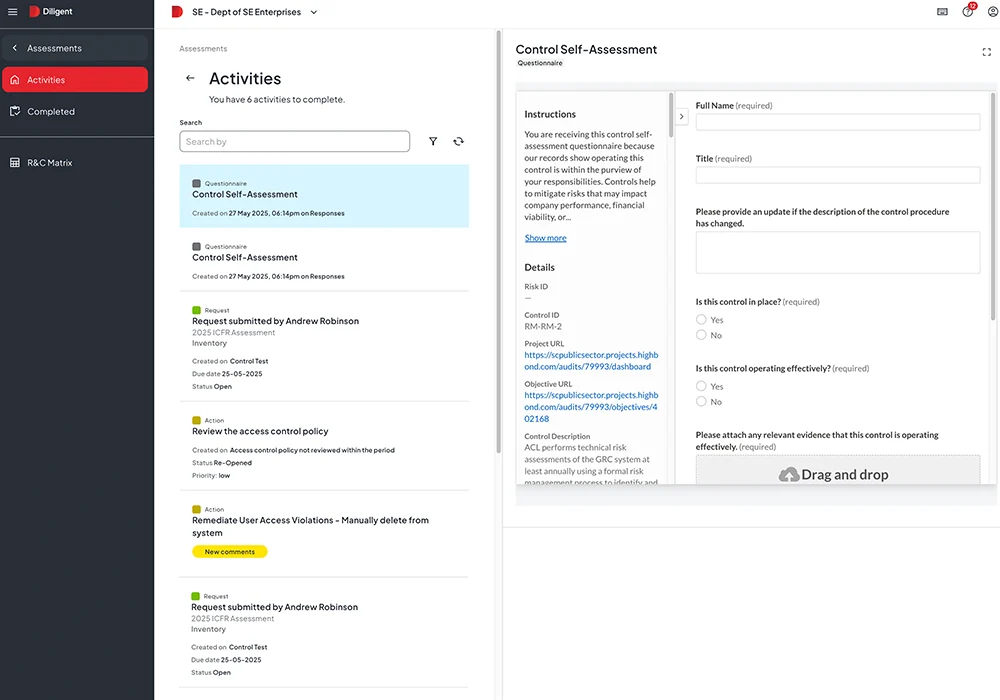
The platform automates routine surveillance tasks while enabling auditors to focus on strategic risk analysis and advisory services that support audit committee oversight.
Analytics alone don't transform audit effectiveness without workflow integration. Leading platforms centralize audit planning, execution and reporting in unified systems. This integration ensures analytical findings flow seamlessly into audit documentation and reporting.
Diligent Internal Controls Management enables continuous monitoring of controls across the organization. Real-time dashboards track control performance, automated alerts flag exceptions requiring investigation and trend analysis identifies control degradation before failures occur. This continuous intelligence enables proactive risk management that traditional periodic audits cannot provide.
These capabilities work in concert to transform internal audit from periodic assurance activities into continuous strategic advisory services. Audit committees receive real-time risk intelligence supporting decision-making rather than historical reports confirming what already occurred.
Ready to transform your internal audit function from periodic assurance to continuous strategic intelligence? Schedule a demo to see how Diligent delivers the risk intelligence your audit committee expects.
Internal audit process automation gives auditors better tools to perform their work, while automated internal controls are system-enforced guardrails built into business processes themselves. One automates how auditors conduct oversight; the other automates the business processes they review.
Full transformation requires 18-36 months, depending on starting maturity and organizational complexity. However, initial value delivery happens much faster. Pilot implementations showing measurable results typically complete in 3-4 months.
Most organizations see significant efficiency gains and expanded coverage within the first year while continuing to build capabilities.
Conservative business cases show payback in 18-24 months through efficiency gains and risk reduction. Specific returns vary by organization size and starting maturity.
Common automated audit benefits include:
Automation strengthens this relationship. External auditors increasingly rely on internal audit data analytics as audit evidence, potentially reducing sample sizes and lowering audit fees. Automated controls testing and continuous monitoring provide comprehensive documentation that external auditors value.
Many external audit firms encourage internal audit automation because it improves the overall quality of the control environment.
Schedule a demo to see how Diligent's integrated audit platform can accelerate your automation journey.





