
Internal audit and risk management functions operate in a dynamic balance within large organizations. As regulatory complexity increases and business risks evolve, the relationship between these functions becomes increasingly critical for effective governance.
The question isn't whether internal audit should participate in enterprise risk management, but how to maximize audit's strategic value while preserving the independence and objectivity that makes audit assurance credible.
Enterprise organizations face pressure to demonstrate comprehensive risk oversight. Board members expect someone to check that management’s risk processes work well. Regulators require evidence of risk-based controls, while stakeholders demand transparent risk disclosure.
Internal audit sits at the center of these expectations, providing an objective assessment of how well organizations identify, assess and mitigate risks across the enterprise. This reality is reflected in expanding audit responsibilities: nearly one-third of chief audit executives (CAEs) now have direct responsibility for enterprise risk management at their organizations, compared to just 24% nine years earlier, according to The Institute of Internal Auditors.
In this article, we’ll explain:
Internal audit provides independent assurance that risk management processes work effectively. While risk managers own the process of identifying and mitigating risks, internal audit evaluates whether those processes achieve intended outcomes — a distinction that preserves audit's independence and credibility with boards and stakeholders.
"There needs to be collaboration between risk and the business, vertically up and down but then also horizontally across the organization. It is absolutely essential — collaboration across risk departments. The problem is there are silos. Risk and audit are interconnected and interdependent. Collaboration helps provide audit's perspective, their insight across company policies and procedures that help improve risk's function," says Michael Rasmussen, CEO of GRC Report.
Internal audit's primary responsibilities in ERM include:
The key distinction: Risk managers own risk processes. Internal audit validates that those processes work.
The relationship between enterprise risk management and internal audit requires careful calibration. These functions must collaborate to deliver risk oversight while maintaining clear boundaries that preserve audit independence.
Risk-based audit planning benefits from ERM insights about emerging threats and changing risk profiles. When audit teams align their coverage with the organization's risk register, they provide assurance on the areas that matter most to leadership and the board.
Information sharing enhances both functions. Risk managers gain audit's comprehensive view across organizational silos. Auditors access risk intelligence that helps them focus on areas of greatest concern.
Joint reporting to audit committees can provide integrated perspectives on risk and control effectiveness. When presented thoughtfully, combined insights help boards understand not just what risks exist but how well the organization manages them.
"Trust is the number one thing. Once you have trust that the executive teams believe in the data, believe in the risk you are identifying, then you can have fulsome conversations, you can create change," says Tom Keaton, former Director of Internal Audit at Crown Castle.
Internal auditors should not assume management responsibility for risk processes. Designing risk management frameworks, conducting risk assessments or implementing risk mitigation strategies compromises the audit team’s ability to provide independent assurance on these activities.
Audit should not own or manage the risk register. While audit findings may inform risk assessments, the audit team cannot both maintain the authoritative risk record and provide independent assurance on its accuracy.
Decision-making about risk appetite and acceptable risk levels remains a management responsibility. Audit can evaluate whether decisions align with stated risk appetite, but cannot determine what that appetite should be.
This balanced approach recognizes that internal audit involvement in enterprise risk management should enhance organizational risk management without compromising the independence that makes audit assurance valuable.
Discover how AI-powered audit platforms enable comprehensive risk assurance while preserving the independence that makes audit credible.

Internal audit functions possess several characteristics that make them ideally suited for risk management oversight:
The Institute of Internal Auditors' 2025 Global Standards emphasize the internal audit's evolving role in providing assurance on risk management, governance and control processes. These updated standards recognize that audit teams must adapt to new risk environments, including cybersecurity, artificial intelligence, environmental sustainability and geopolitical uncertainty.
Key to effective risk management collaboration is the ability of compliance and internal audit teams to work together while preserving the independence that makes audit oversight valuable. One frequently asked question relates to distinct roles held by compliance and internal audit teams during risk assessment processes.
The roles should remain clearly differentiated. While compliance teams carry out ongoing measurement of their processes and effectiveness, the audit process provides objective, independent evaluation of compliance and risk management at given points in time.
This typically involves annual events that take an objective look at compliance and risk management systems.
Current best practices implement the Three Lines Model to maintain proper role boundaries:
When it comes to risk oversight, the internal audit's primary function is to provide organizational boards and senior leadership assurance that the business manages risk successfully.
This assurance is two-fold: confirming that the organization's biggest business risks are managed effectively, and that the processes governing and monitoring risk management are themselves effective.
While internal audit brings substantial value to ERM oversight, certain activities compromise independence and should be avoided:
These boundaries reflect fundamental principles of audit independence outlined in professional standards. Organizations that ask internal audit to blur these lines compromise the credibility of audit assurance and may face regulatory scrutiny or audit committee concerns.
The risk landscape continues to evolve rapidly, requiring internal audit functions to expand traditional control testing into new domains:
These emerging risk areas require internal audit to develop new competencies, leverage specialized expertise and adopt technologies that enable more comprehensive (and continuous) risk assessment.
Download the 7-step guide for risk leaders on moving from reactive processes to proactive ERM that drives smarter decisions and stronger oversight across audit and risk functions.

Artificial intelligence and advanced analytics fundamentally change how the internal audit team participates in enterprise-wide risk management. Traditional sample-based testing and annual assessments give way to comprehensive data analysis, continuous monitoring and predictive risk identification that addresses the coordination challenges and independence requirements discussed throughout this guide.
For organizations managing complex enterprise risk assessment requirements, AI-powered platforms like Diligent address the manual testing and limited data coverage challenges that compromise audit effectiveness. Here’s how:
Diligent’s audit management software delivers AI-driven audit capabilities that reduce routine task completion time while improving audit finding accuracy. The platform's continuous monitoring systems provide real-time risk intelligence and automated exception identification, enabling "always-on" auditing that traditional periodic assessments cannot match.
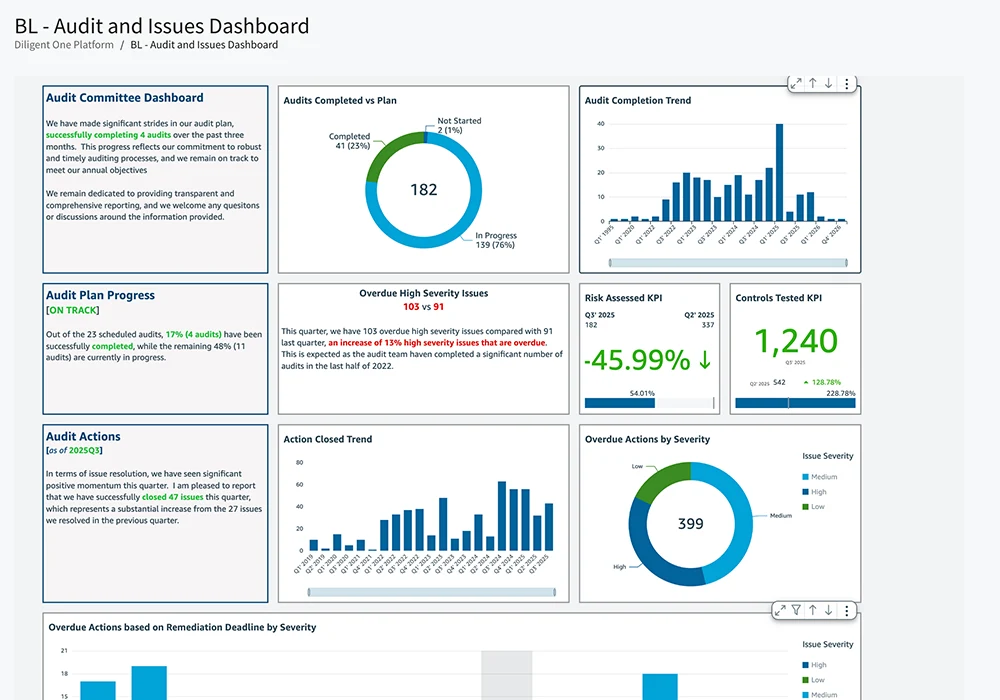
This transformation allows audit teams to focus on investigation, root cause analysis and advisory work rather than manual data gathering and testing.
Building on this, ACL Analytics complements risk management with no-code analytics capabilities and natural language query processing. Internal auditors examine complete data populations rather than small samples, identifying anomalies and patterns that manual testing would miss.
For enterprise-wide risk coordination, Diligent ERM integrates audit findings with comprehensive risk management workflows. The platform's AI-powered risk identification benchmarks against 180,000+ real-world risks from public company disclosures, providing the external intelligence that strengthens both audit planning and risk assessment.
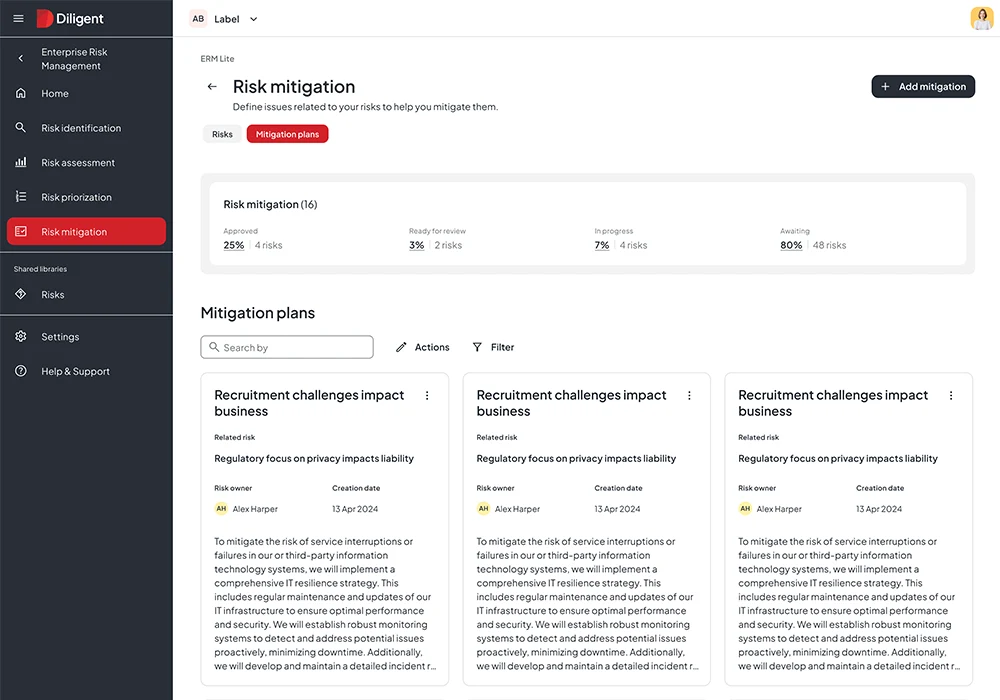
Integration between audit and risk platforms enables seamless coordination without compromising independence, providing boards with unified perspectives on organizational risk posture and control effectiveness.
Ready to transform your internal audit team’s approach to risk management? Discover how Diligent's connected governance platform enables more effective audit assurance while strengthening enterprise-wide risk management. Request a demo to get started.
Internal auditors should never assume management responsibilities for developing or implementing risk management processes that they will later assess. This creates obvious conflicts of interest when reviewing effectiveness.
Similarly, internal auditors providing assurance on risk management should not be involved in deciding whether these assurances are adequate.
Implement clear role boundaries using the Three Lines Model framework. Internal audit can advise on best practices and improvement approaches, but must avoid operational responsibilities.
Maintain dual reporting structures with functional reporting to the audit committee for independence and administrative reporting to management for operations.
Internal audit should prioritize cybersecurity and IT risk, AI governance and emerging technology risks, ESG data integrity and reporting, third-party risk management, and geopolitical and economic uncertainty.
These represent the areas of greatest organizational concern and regulatory compliance focus. Internal audit functions that develop specialized capabilities in these domains provide substantially greater value to organizations and boards while positioning themselves as strategic partners in enterprise risk management rather than backward-looking compliance functions.
While traditional approaches involved annual risk management assessments, leading organizations now implement continuous audit approaches that provide ongoing evaluation of risk processes. The frequency depends on organizational complexity, risk environment volatility and regulatory requirements.
Most enterprise organizations conduct formal risk management reviews at least annually, supplemented by continuous monitoring of key risk indicators and controls. Audit committees typically review the internal audit team’s assessment of risk management effectiveness quarterly as part of broader risk oversight.
Ready to transform your internal audit risk management capabilities? Book a demo to discover how Diligent can deliver immediate efficiency gains while expanding risk coverage across your organization.