
New! AI Board Member: Walk into every meeting knowing nothing was missed. Request early accessarrow_forward
Diligent Logo
Diligent Logo
Products
arrow_drop_down
Solutions
arrow_drop_down
Resources
arrow_drop_down
Diligent AI

Board pack management: a complete guide to building better board packs

July 9, 2026
21 min read
A corporate secretary preparing a board pack before a meeting

In this article

  • Intro
  • What is a board pack?
  • What is included in a board pack?
  • Board pack preparation
  • How AI is changing board packs
  • Board pack requirements around the world
  • Board packs and regulatory compliance
  • How to create an effective board pack
  • Board pack examples and templates
  • 7 tips for effective board pack management
  • Common board pack mistakes to avoid
  • Best practices for board pack distribution
  • How to ensure the security of board packs
  • How GovernAI transforms board pack management
  • Selecting the right board pack software
  • FAQs
Meghan Day

Meghan Day

Principal Solution Designer

The average board pack is hundreds of pages long and packed with critical information. This makes board pack management challenging for corporate secretaries to prepare and for the board of directors to read.

How do you capture the multitude of data points and insights the board needs without overwhelming directors with information? Effective board pack management balances clear contents, timely preparation, regulatory compliance, timely distribution, security and the right board management software. Here's how to get each of those elements right, from first draft to director access.


What is a board pack?

A board pack is a structured compilation of documents board members must review before a meeting, typically covering the agenda, financials, risk reports and key decisions.

A board pack is a compilation of the various documents board members must review before a meeting. The size of the board pack can vary depending on the meeting. For example, the annual general meeting is more intensive than a regular board meeting. In all cases, the pack should help guide decision-making.

With the board pack in hand, directors should have all the necessary information to prepare effectively, ask relevant questions and make better decisions for the organization. These packs have traditionally been printed and mailed, but digital transformation has led to simpler digital board packs in recent years.


What is included in a board pack?

A thorough board pack should include all critical documents the board will need to make decisions at the next meeting. Incorporating the right documents into the board pack enables informed discussion, reduces surprises and supports directors in effectively fulfilling their fiduciary duties.

Curating the right information matters more than increasing page count. According to the GC Risk Index 2026 from Diligent Institute, only 21% of senior legal leaders are very confident their board receives the right mix of information on risk: focused, forward-looking and manageable. Clear selection and presentation close that gap better than extra pages.

Board pack contents

A board pack's contents can vary depending on the objective of the meeting, but will generally include:


Board pack preparation

Preparing an effective board pack is as important as the content inside it. The process involves coordinating across executives, committees and administrators, often under tight timelines. Below is a step-by-step framework for building a pack that directors can actually use.

  1. Define the meeting's objectives: Identify the goals of the upcoming meeting. The board pack should be structured around these objectives, focusing on the key decisions boards must make.
  2. Prepare the agenda: The agenda is the foundation of the board pack and outlines primary discussion points. Use a consistent format so directors know exactly where to look.
  3. Set submission deadlines: Define specific timelines for when committees and executives must submit their materials. Clear deadlines prevent late contributions from holding up the entire pack.
  4. Collect and review documents: Gather previous meeting minutes, financial reports, committee updates and any supporting materials. Review for accuracy and completeness before compiling.
  5. Organize in priority order: Arrange documents so the most critical items come first. A clear structure with section headings and a table of contents helps directors find what they need quickly.
  6. Distribute at least 7–10 days before the meeting: Board members need adequate time to review materials. For complex or high-stakes meetings, 10–14 days is ideal.

Boost board pack prep with AI

See how AI can streamline board pack preparation from start to finish.

Team mates discussing board governance

How AI is changing board packs

Corporate secretaries have been creating board packs for decades. However, artificial intelligence is changing the work that secretaries and other board administrators must complete to create and distribute usable board packs. The result is faster preparation and more useful materials. AI can affect board pack work in several ways:
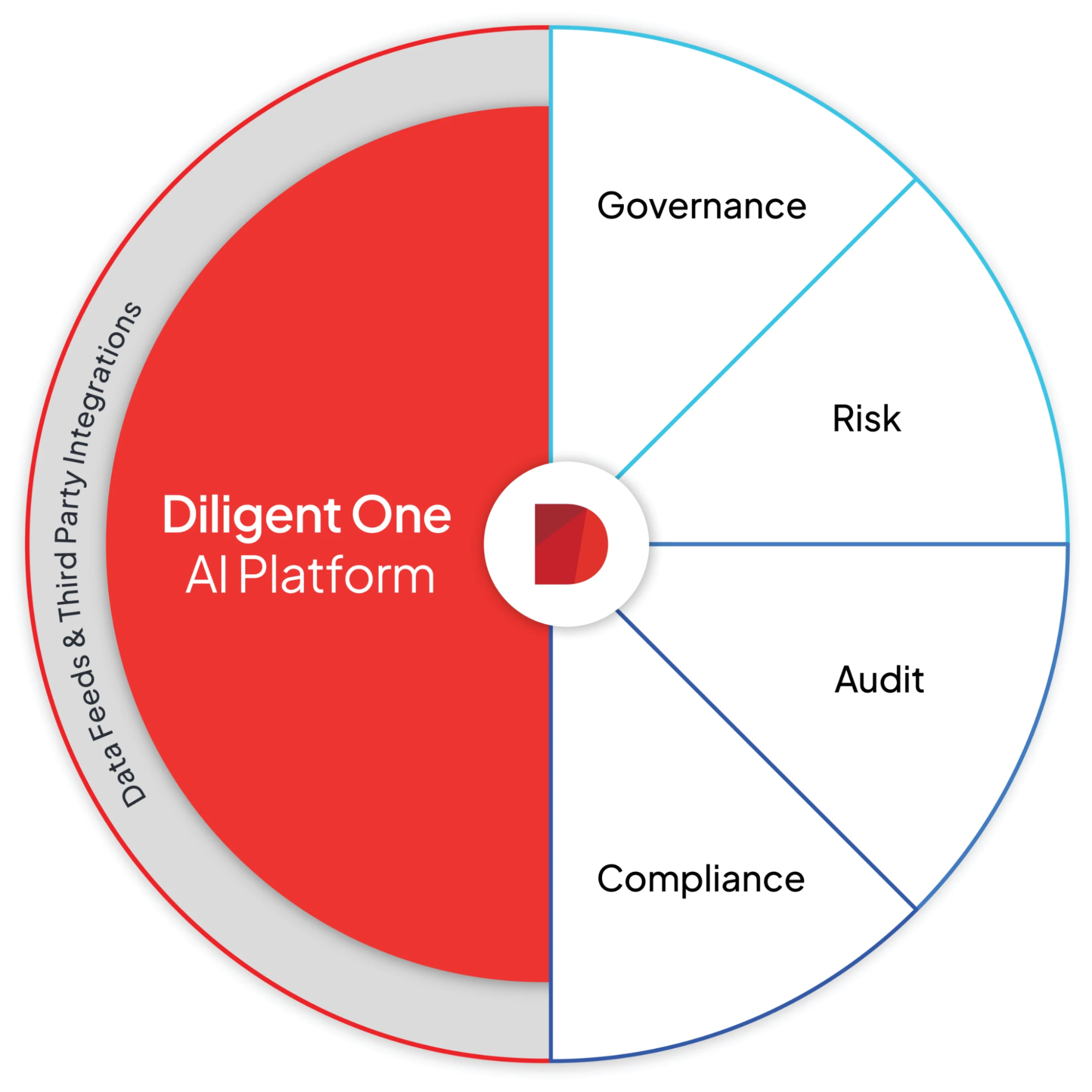
  • Automated content generation: AI-powered tools can draft meeting agendas, executive summaries and even initial board minutes using natural language processing. This can save hours of manual work.
  • Smart document organization: Machine learning helps structure and prioritize content within board packs, so directors can easily tap into the data they need to identify key risks, make decisions and prioritize insights.
  • Real-time data and dashboards: AI-powered tools can integrate live data feeds, generate predictive analytics and visualize KPIs in real time. This gives boards a clear view of performance and emerging trends.
  • Search and summaries: AI enables directors to quickly search across board packs, highlight key insights and receive instant summaries of complex documents.
  • Improved compliance and risk detection: AI can flag inconsistencies, detect anomalies in financial reports and surface potential compliance issues before they become problems.
Diligent picture showning Data Feeds and Third Party contibutions

According to What Directors Think 2026 by Diligent Institute and Corporate Board Member, 58% of directors want more meeting time devoted to strategic planning and 42% want fewer presentations. AI-assisted summaries are the mechanism that moves routine updates into concise pre-reads and frees meeting time for decisions that require director judgment.

According to What Directors Think 2026, directors' next-meeting agenda priorities include strategic planning (47%), AI and other digital and technology risks (44%) and M&A opportunities (35%). Pack compilers can use these signals to lead with the materials that matter most to the board's agenda.

Organizations can start integrating AI into board pack creation and review.

Driving boardroom success with AI-powered governance technology

ELCO Mutual Life and Annuity is a 78-year-old insurance and financial services provider. The company had a long history of serving policyholders. The company wanted its governance structure to support growth goals and resilience in a changing market.

"We were using one file sharing product which just didn't work well," says Eric Myers, general counsel at ELCO. "I would get calls and emails from directors saying they couldn't access or open files."

This inefficient setup burdened Myers and the IT department. It distracted them from more critical tasks. As he put it, the situation became "non-workable" and required immediate intervention to enable more effective governance. Myers started by restructuring the board, but adopting Diligent Boards changed the process.

"I could set up the books for all meetings, publish them and share drafts with certain people before finalizing," Myers said.

Myers and the ELCO team use Diligent Boards features like:

  • AI-generated minutes that transform how minutes are prepared; teams spend just minutes rather than a few hours
  • AI Smart Summary tool to create concise overviews of 150-page board books with the click of a button
  • A centralized resource tab that enables directors to easily access essential documents and minimize reliance on Myers for basic inquiries

"It's really cool," says Myers. "Diligent's AI Board Book Summary tool basically summarizes everything, and I can pull the bits and pieces that I need. Having something that tells the board, 'Hey, this is where you need to go, this is what you should focus on,' is very helpful."
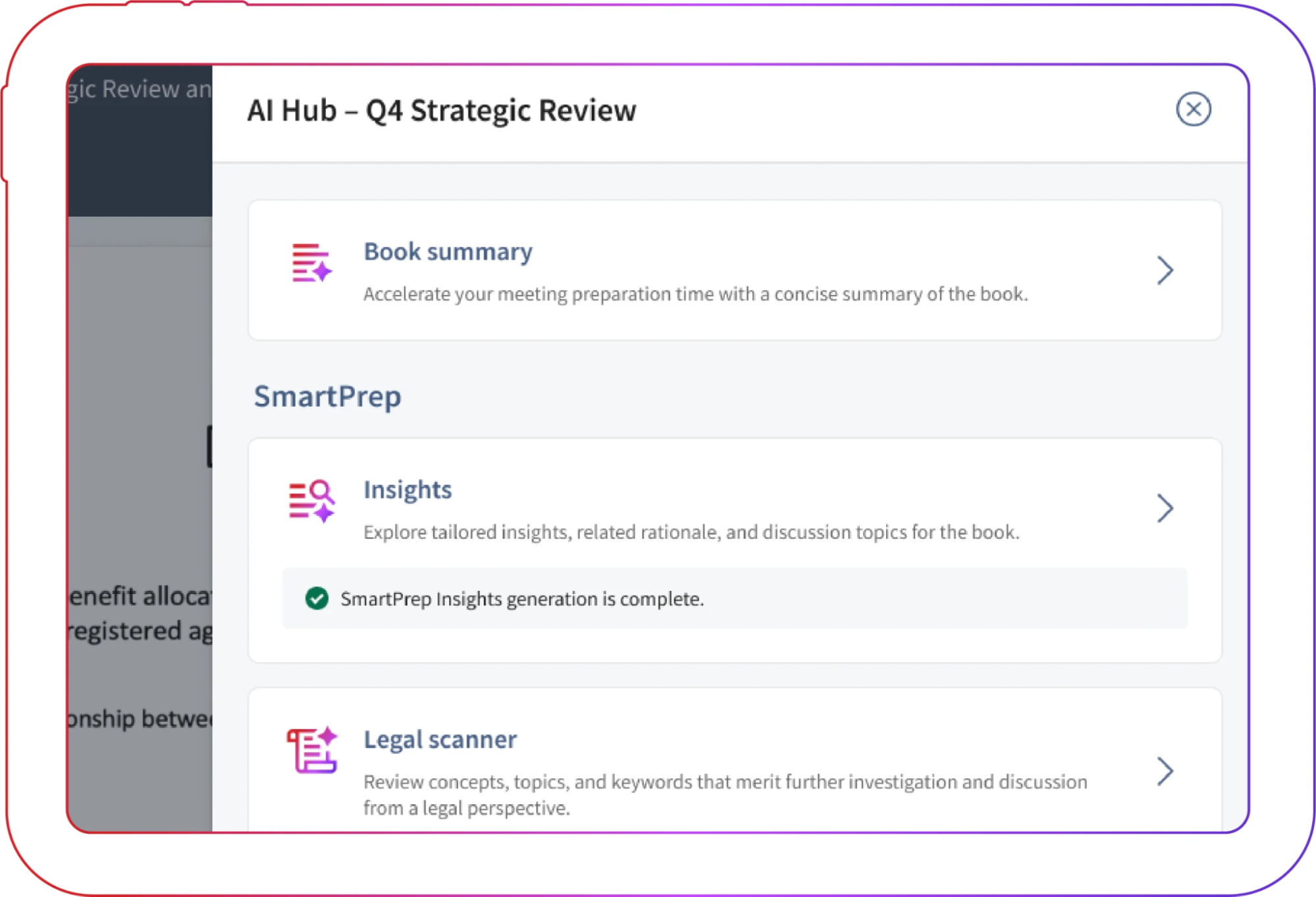
Diligent picture showing AI Hub - Q4 Strategic review

After adopting Diligent Boards and GovernAI, Myers reduced board pack preparation from a full day or two to roughly 1–2 hours.

Put your board books on autopilot

Discover how Diligent’s GovernAI tools eliminate manual board meeting prep, freeing up time, boosting productivity and equipping leaders with real-time insights.

Two board members using Diligent's GovernAI to streamline their board pack

Board pack requirements around the world

Many board packs have similar contents. However, what constitutes a compliant board pack can vary by country, with influence from governance standards, regulatory frameworks and corporate culture. Expectations differ across key regions:

United States

U.S. board packs are expected to meet fiduciary duty standards under state corporate laws (for example, Delaware General Corporation Law). Plan to deliver materials at least one week in advance, with clear summaries, risk disclosures and financials. Public companies must also comply with SEC disclosure and Sarbanes-Oxley requirements.

United Kingdom

UK companies follow the UK Corporate Governance Code, which emphasizes transparency and timely information. Board packs should include materials needed for informed, independent judgment, with special attention to risk, compliance and stakeholder interests. Directors must have "sufficient time and information" to carry out their duties.

Australia

Under the ASX Corporate Governance Principles and Corporations Act 2001, Australian boards must receive timely, relevant and accurate information. Board packs often include detailed risk assessments and ESG metrics. Directors have a statutory duty of care and diligence. The quality and timing of board packs are therefore critical.

European Union

EU governance practices vary by country, but many align with the EU Shareholder Rights Directive II and national codes (e.g., Germany's Corporate Governance Code). Board packs must support long-term value creation, transparency and director accountability. They often include non-financial reporting (e.g., sustainability, diversity metrics) alongside financials.


Board packs and regulatory compliance

Board packs play an important role in helping organizations meet regulatory compliance requirements. When adequately prepared, they demonstrate that directors fulfill their legal and fiduciary duties by making informed decisions, documenting oversight and managing risk effectively.

Only 21% of senior legal leaders report being very confident that their board receives the right mix of risk information, according to the GC Risk Index 2026 by Diligent Institute. Board pack curation is a quality challenge, not a volume problem.

Why compliance matters in board packs

  • Fiduciary duties: Directors must act with care, loyalty and good faith. Board packs provide the documentation that supports this responsibility.
  • Audit and financial oversight: Accurate, timely financial data in board packs ensures boards meet standards set by regulators like the SEC in the U.S., ASIC in Australia, FCA in the UK or national bodies in the EU.
  • Risk and governance documentation: Compliance frameworks often require that material risks, conflicts of interest and compliance breaches are disclosed and discussed, typically within the board pack.
  • Recordkeeping: Organizations should retain board materials and decisions, especially in sectors like finance, healthcare and publicly listed companies.

Key compliance considerations

  • Timeliness: Materials should be distributed well before the meeting to allow for proper review, often five to seven days in advance.
  • Completeness: Include all relevant disclosures, financial reports and legal documents.
  • Audit trails: Use secure platforms that track access, updates and approvals for accountability.
  • Data privacy: Board packs often contain sensitive information. Use a platform that ensures compliance with data protection laws such as GDPR, HIPAA or applicable regulations.

How to create an effective board pack

The best board packs walk the fine line between providing enough information to the board without overloading them with details they can't feasibly review before the meeting. To master clear, yet concise, board pack preparation:

  1. Define the meeting's objectives: Identify the goals of the upcoming meeting. AI can also help surface past decisions and highlight recurring themes or unresolved issues to inform your materials. The board pack should be structured around these objectives, focusing on the key decisions boards must make.
  2. Prepare the agenda: The agenda is the foundation of the board pack and outlines primary discussion points. Including this helps the board organize its thoughts on key issues. Use AI to auto-generate agenda drafts based on past meeting topics, saving time and ensuring nothing falls through the cracks.
  3. Collect essential documents: Gather previous meeting minutes and other documents reflecting past decisions and discussions. This will keep all directors on the same page.
  4. Include reports: Any committees or departments that will report during the meeting should submit their report for inclusion in the board pack. This includes a summary from the CEO, financial, risk and compliance reports and committee updates. With AI, you can summarize long reports into digestible executive summaries. This makes it easier for board members to absorb key insights.
  5. Organize documents: Arrange documents in order of priority. The most critical items should come first so they receive the directors' full attention. For more complex information, incorporate AI-generated visualizations or summaries to improve readability.
  6. Make the pack easy to use: As you organize documents, maintain a logical order. Start with the agenda, followed by key reports and end with supporting documents. A clear, consistent format with section headings can help directors find what they need.
  7. Distribute in advance: Board members need time before the meeting to review the board pack. Aim to distribute it at least 10-14 days before the meeting to ensure all directors are well prepared to engage in the discussion. Many board portals now use AI to send personalized reminders and track whether directors have accessed and reviewed materials. This helps ensure everyone comes prepared.

Board pack examples and templates

Knowing what to include is one thing, seeing it in practice is another. Below are examples of the core components that appear in most board packs, along with template resources for each.

Agenda example

The agenda will typically include:

  • Meeting date and time
  • Location/platform
  • Items to be discussed
  • Time allocations for each topic

See a full board meeting agenda template.

Previous meeting minutes

This should include a summary of discussions, decisions made and action items from the last meeting. Directors can refer to this document for continuity.

See a complete meeting minutes template.

Executive summary

The summary should be a one- or two-page overview of critical CEO or executive team updates. It should highlight significant developments, challenges and opportunities since the last meeting.

Financial reports

Financial reports should be detailed and include an income statement, balance sheet and a cash flow statement.

See an example of a financial report.

Committee reports

These reports will come from different committees, such as audit or governance, and outline their activities, findings and recommendations for the board.

Strategic initiatives

Updates on projects and initiatives, including performance against goals and any new proposals for the board's consideration. According to What Directors Think 2026, directors' next-meeting agenda priorities include planning, AI and other digital and technology risks and opportunities and M&A opportunities, so the pack should lead with the decisions and risks that matter most.

Supporting documents

Attach additional documents that provide the necessary context. This could be market analyses, competitor reviews or project plans.


7 tips for effective board pack management

Effective board pack management gives board members the right information at the right time. These practices keep the process consistent:

  1. Use board management software: Board packs are lengthy and can take days or weeks to prepare manually. Board management software supports collaboration and centralizes documents so you don't have to chase them down. This simplifies most of these processes.
  2. Standardize the structure: Board packs don't need to be creative. Establishing a standard structure makes it easier for you to prepare and for board members to use. Consistent formatting also helps members keep track of where certain information is.
  3. Set clear deadlines: Part of board pack preparation involves managing those who need to contribute. Define specific timelines for when committees and executives must submit their materials, and also set a clear expectation for when you will ultimately distribute the pack.
  4. Be concise: Avoid overloading the board pack and focus on making information clear and straightforward. Incorporating bullet points, charts and graphics can help directors interpret data quickly.
  5. Encourage executive summaries: The board pack will have a summary, but reports should, too. Including a summary for each report will help the board orient itself around essential information.
  6. Implement version control: Controlling different versions ensures board members have access to the most current documents. This helps avoid confusion and ensures the board only makes decisions based on up-to-date information.
  7. Solicit feedback: After each meeting, gather feedback from board members on the board pack's content and structure. This can help identify where to improve it and board effectiveness.

Common board pack mistakes to avoid

Even well intentioned board packs can fall short if they're poorly organized, overly dense or misaligned with the board's needs. Common mistakes include overloading the pack, delivering it late and organizing it poorly.

  1. Overloading with information: Too much detail can obscure the key takeaways. Instead of including every data point, focus on what's most relevant to the meeting's objectives. Use summaries and appendices for less critical content.
  2. Delivering the pack too late: Board members need time to review materials. Distributing the board pack only a few days before the meeting can lead to underprepared directors and inefficient discussions. Aim for 10-14 days in advance.
  3. Poor organization: A confusing layout or inconsistent formatting slows down review time. Make sure your board pack has a clear structure, with section headings, a table of contents and a logical flow from agenda to key reports.
  4. Lack of long-term focus: Too many operational updates and too little forward-looking content can dilute board engagement. Ensure each board pack includes forward-looking insights, major risks and decisions requiring board input.
  5. Missing or outdated information: Failing to include current financials, accurate risk reports or updated KPIs undermines the board's ability to govern effectively. Cross-check all materials for accuracy and completeness.
  6. Ignoring AI and automation tools: Manual processes slow you down and increase the risk of errors. Today's AI tools can help you summarize content, flag inconsistencies, organize documents and visualize data, all of which improve clarity and efficiency.

Best practices for board pack distribution

Preparing the board pack is vital, but so is distributing it. Efficient distribution ensures board members receive critical information on time.

A static PDF mailed once before each meeting also leaves a gap. According to What Directors Think 2026 by Diligent Institute and Corporate Board Member, 47% of directors receive real-time data between meetings only sometimes or rarely. Continuous, digital board packs delivered through a secure portal can help directors stay informed between meetings rather than only when the next pack lands.

  1. Set a distribution timeline: Establish a clear timeline for distributing board packs, usually 7-10 days before the meeting. Board members will know to expect the materials and have sufficient time to review them.
  2. Ensure accessibility: All board members need easy access to the board pack, whether at the office or across the country. Ensuring compatibility with different devices can aid accessibility. Distributing electronic board packs through a secure portal ensures directors can access materials on any device, from anywhere.
  3. Include instructions: Tell board members how to access the materials and engage with them, especially if using a new governance platform. This can help mitigate confusion after board packs go out.
  4. Encourage acknowledgment of receipt: Ask board members to confirm that they've received the board pack. This helps identify any potential issues with access.
  5. Highlight key documents: Direct the board to critical documents or sections. This will allow the board to focus on the most essential items first.
  6. Use AI for tailored alerts and follow-up: AI can help automate scheduling, send distribution reminders and flag delays. This can help maintain consistency. It can also alert board members to updates, new documents or questions they may have missed, so every director arrives prepared.

Boost board management with AI

Discover how you can use AI to boost board efficiency, decision-making and strategic planning, starting with better board books.

Board members using AI to boost board room efficiency and improve their board pack

How to ensure the security of board packs

Board packs are full of sensitive information, so security is paramount. The security of board packs is also a legal and regulatory requirement. To protect board packs:

  1. Use secure platforms: Board management software with encryption, secure logins and permission settings has built-in protections against breaches and unauthorized access.
  2. Implement role-based access control: Assign access levels based on board members' responsibilities. This ensures that only authorized individuals can access or edit sensitive materials.
  3. Encrypt documents: Storing and transmitting board packs using encryption prevents bad actors from accessing sensitive information.
  4. Update security protocols: Stay up-to-date on cybersecurity threats and refresh your protocols accordingly. This includes software updates, security patches and staff training.
  5. Monitor and audit access: Track who accesses board packs and when. Regular audits can identify unauthorized attempts or when to remove users if they are no longer with the company.

How GovernAI transforms board pack management

The manual effort, version confusion and information overload documented throughout this guide represent exactly the problems AI-powered governance platforms address. Diligent Boards and its GovernAI suite were built to automate repetitive tasks, surface the right information and help directors and leaders arrive prepared.

GovernAI includes five core AI capabilities for board pack work:

  • AI Smart Builder automates the document synthesis that typically consumes hours per board cycle. Rather than manually assembling packs from multiple sources, governance teams can generate professional board books in a fraction of the time.
  • AI Smart Summary distils a long pack into the pages directors actually need. For organizations like ELCO, this moved board pack preparation from a full day or two to roughly 1–2 hours, and directly supports the 42% of directors who want fewer presentations.
  • AI Smart Minutes drafts meeting minutes from the pack, agenda and notes, cutting what was once a several-hour task down to minutes.
  • AI Smart Risk Scanner flags risky language and legal red flags in board materials before they are published, giving general counsel confidence that the pack is clear of unintended exposure.
  • Action Tracker converts decisions from board meetings into tracked follow-up items, closing the loop between meeting and execution.

Assore Holdings' company secretary team saved board meeting preparation time using Diligent Boards and GovernAI, confirmed in the Assore Holdings case study.

For teams in the public sector, Diligent Community provides the same secure, centralized approach to meeting packets, built for the transparency and access requirements of public bodies.
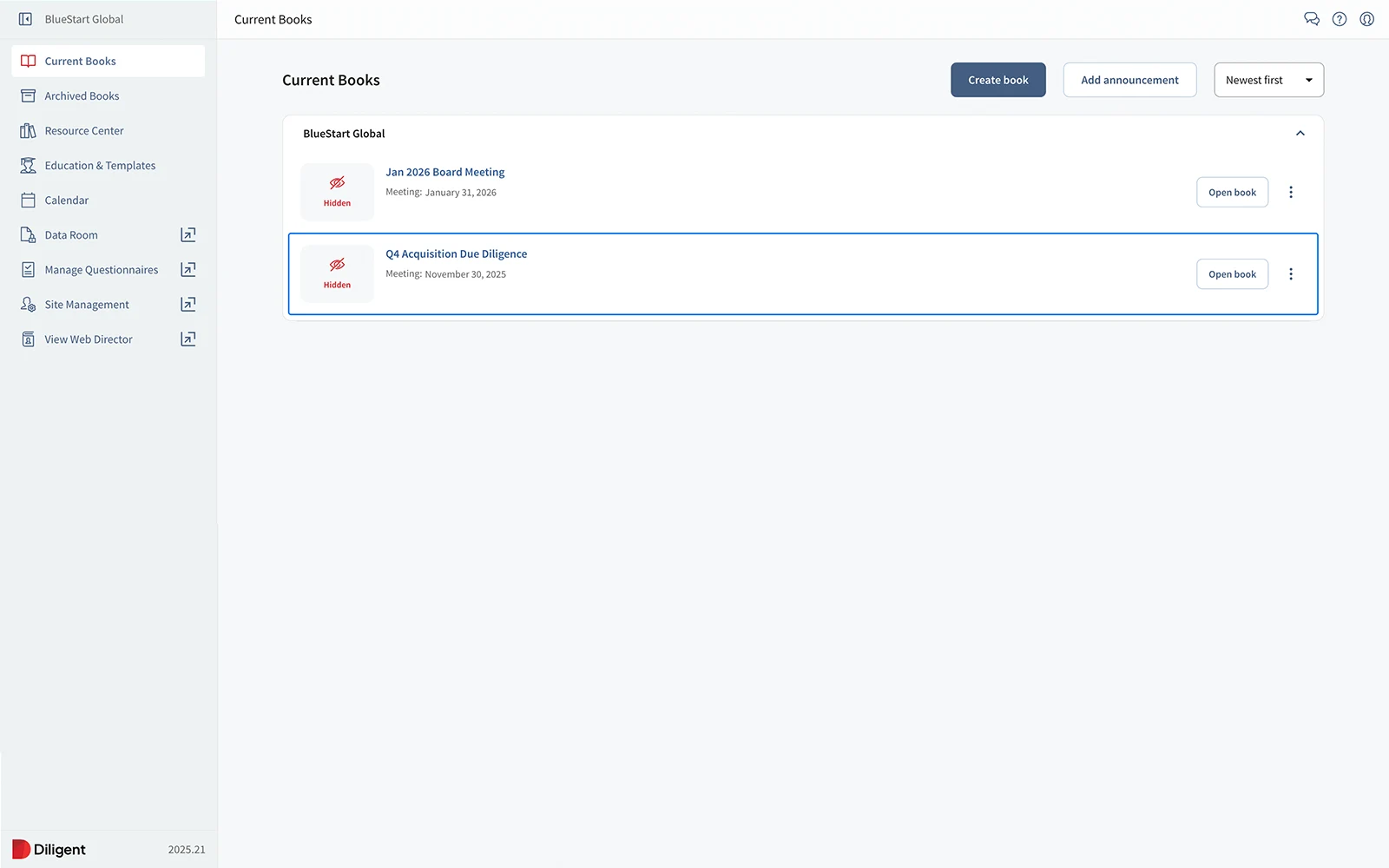
Picture of Diligent Dashboard

Diligent Boards is used by organizations in 130+ countries. Request a demo to see how GovernAI can transform your board pack process.

Which AI platform fits you?

Find out why Diligent AI is the #1 board management software for boards that want to make better decisions faster.

Board members using Diligent AI to make board pack creation easier

Selecting the right board pack software

Board pack software is important for today's boards. But with countless board pack software solutions available, how do you identify the right tool for your board?

Download our buyer's guide to board management software to explore the key questions you should ask about any governance technology solution before you purchase it.


FAQs

How often should board packs be distributed?

Board packs should be distributed before every board meeting, typically 7-10 days before the meeting date.

How can I ensure that board members receive and review board packs in a timely manner?

You can ensure board members receive and review board packs in a timely manner by creating a clear distribution timeline, asking them to confirm receipts and using a board portal to send them automatic reminders.

How can I make board packs more engaging and effective?

You can make board packs more engaging and effective by making them clear and concise. Incorporate visuals and summaries to make more complex data digestible and easy to use.

Are there any security concerns with using board portal software?

There are several concerns with using board portal software, however they are more common with free solutions. Free technology may be more prone to breaches and unauthorized access, while premium solutions use encryption and other cybersecurity controls.

Who is responsible for preparing a board pack?

The responsibility for preparing a board pack typically falls to the company secretary, governance professional or executive assistant supporting the board. In some organizations, legal or compliance teams may also be involved, especially when regulatory or risk-related materials are included. The preparer works closely with senior executives (e.g., CEO, CFO, committee chairs) to gather reports, organize content and ensure materials are accurate, relevant and distributed on time.

When should a board pack be distributed before a meeting?

A board pack should be distributed at least 7 to 10 days before a board meeting. This gives directors enough time to read, analyze and prepare for meaningful discussions. For complex or high-stakes meetings, 10–14 days is ideal. Timely distribution also supports compliance with governance standards and reduces the risk of rushed or uninformed decision-making.

Can board packs be shared via email?

Board packs can be shared via email, but email raises security risks, version control issues and limited tracking capabilities. Sensitive board materials should be shared through secure board portals or governance platforms that offer encryption, access controls and audit trails.

How long should a board pack be?

Length depends on the organization, meeting type and complexity of issues, but most effective board packs are 30 to 100 pages. The key is quality over quantity: board packs should be concise, relevant and focused on the board's work. Use executive summaries, visual dashboards and appendices to simplify dense material.

Can AI improve board packs?

Yes, AI is changing how board packs are created, reviewed and distributed. AI tools can:

  • Auto-generate meeting agendas and executive summaries
  • Analyze trends across past board materials
  • Flag missing or inconsistent data
  • Improve search and document tagging

This results in faster preparation, better insight and more board engagement. Discover how Diligent is using AI to improve governance workflows.

What is the difference between a board pack and a board report?

A board pack is the full collection of documents distributed before a board meeting, encompassing the agenda, financials, committee reports and supporting materials. A board report is a single document, typically from management, a committee or an external adviser, that forms one component within the pack. For guidance on structuring effective board reports, see our guide to board reporting.

What are the best tools for creating and distributing board packs?

The best board management tools combine secure document sharing, real-time collaboration and, increasingly, AI-powered features that simplify the entire board pack process from creation to distribution to archival.

Platforms can offer intuitive dashboards, smart agenda builders and features that improve transparency, reduce manual work and help boards focus on what matters most: decision-making. Download our board management software buyer's guide to get a complete list of criteria to guide your software search.

Ready to transform your board pack process? Request a demo to see how Diligent Boards and GovernAI can help.




